

 GMKB
GMKBChristelle Lteif; Larisa H. Cavallari
- DOI: 10.3389/fphar.2026.1817652
- Article on Jama Network
Christelle Lteif; Larisa H. Cavallari
A new manuscript from the IGNITE Pragmatic Trials Network has been published in JAMA Network Open, describing results from the ADOPT PGx Depression trial. The randomized clinical trial evaluated whether genotype-guided prescribing of selective serotonin reuptake inhibitors (SSRIs) could improve outcomes for patients with depression.
The study enrolled 1,460 adults and children receiving care in primary care, psychiatry, and family medicine clinics across the United States. Researchers examined whether pharmacogenetic information related to CYP2D6 and CYP2C19 — genes that influence how individuals metabolize antidepressants — could help guide SSRI prescribing compared with usual care.
Among participants with actionable pharmacogenetic profiles, genotype-guided prescribing did not significantly improve depression symptom scores at 3 months, the study’s primary endpoint. However, patients in the genotype-guided group experienced higher rates of depression remission at 6 months than those receiving usual care, suggesting a potential longer-term benefit of pharmacogenetic-informed prescribing.
GenomeWeb coverage of the publication underscored the study’s broader relevance to the evolving role of pharmacogenetics in depression care, particularly as psychiatry guidelines continue to weigh the evidence for routine implementation. The ADOPT PGx findings contribute important new data to that discussion, highlighting both the promise of precision medicine approaches and the need for further research on long-term outcomes, clinical implementation, and access.
Together, these findings add meaningful evidence to ongoing efforts to understand how precision medicine strategies may support more individualized depression treatment and improve antidepressant response over time.
Read the publication here.
Kathryn V. Blake, PharmDLindsay J. Hines, PhDMichelle Liu, PharmD
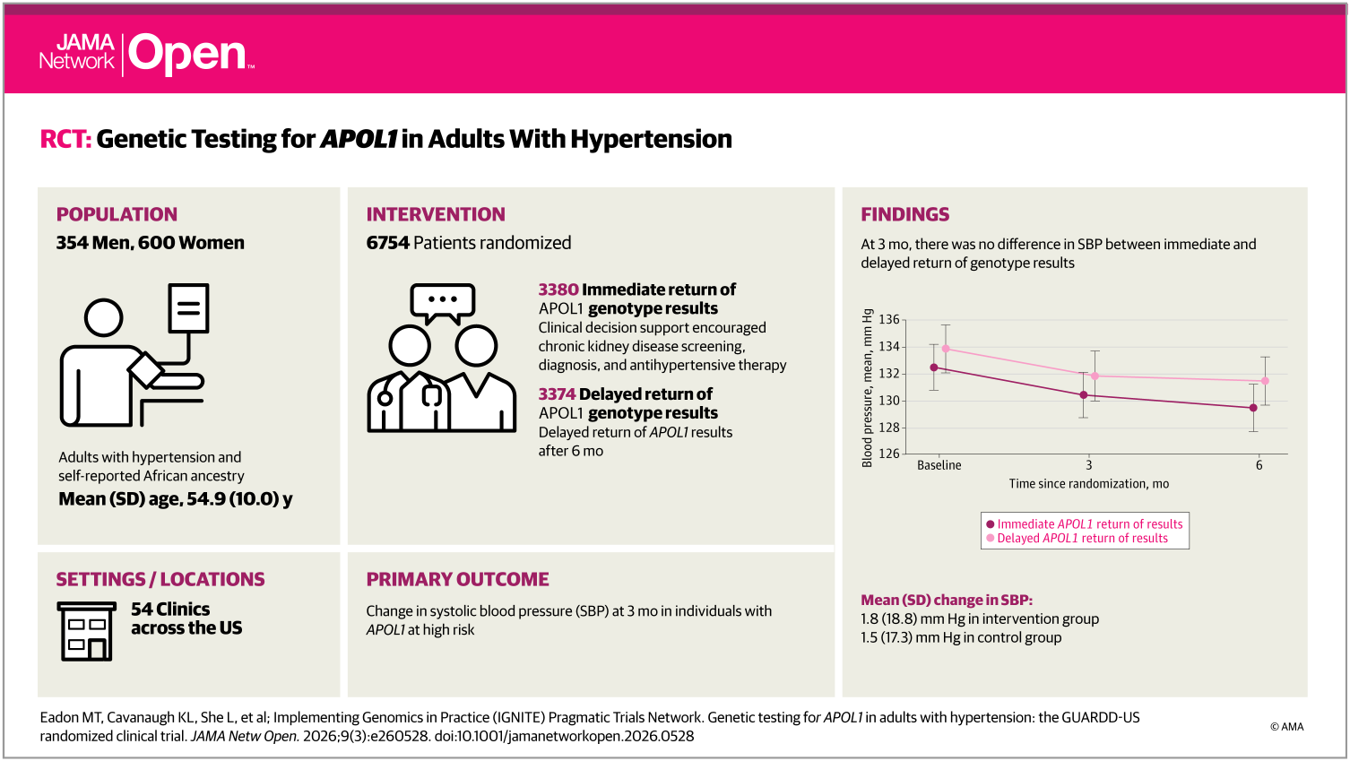
A new manuscript from the IGNITE Pragmatic Trials Network has been published in JAMA Network Open, describing the primary results of the GUARDD-US study. GUARDD-US is a randomized controlled trial examining the impact of returning APOL1 genetic risk results to patients with hypertension and their clinicians. The study explores whether knowledge of genetic risk for kidney disease can influence blood pressure management and chronic kidney disease (CKD) screening in routine clinical care. GUARDD-US enrolled more than 6,700 participants with self-reported African ancestry across 54 clinical sites in the United States, reflecting populations disproportionately affected by hypertension and CKD.
The primary outcome assessed changes in systolic blood pressure three months after randomization among individuals with APOL1 high-risk genotypes. Overall, immediate disclosure of genetic results was not associated with a significant reduction in systolic blood pressure compared with delayed disclosure. However, among participants who had uncontrolled blood pressure at baseline, those who received their genetic results experienced greater improvements in blood pressure control.
Importantly, returning APOL1 results also influenced clinical care beyond blood pressure management. Participants and clinicians who received immediate genetic results were more likely to pursue CKD screening and had higher rates of CKD diagnosis, highlighting the potential of genomic information to support earlier detection of kidney disease in at-risk populations.
Read the publication here.
Michael T. Eadon, MD; Kerri L. Cavanaugh, MD, MHS; Lilin She, PhD
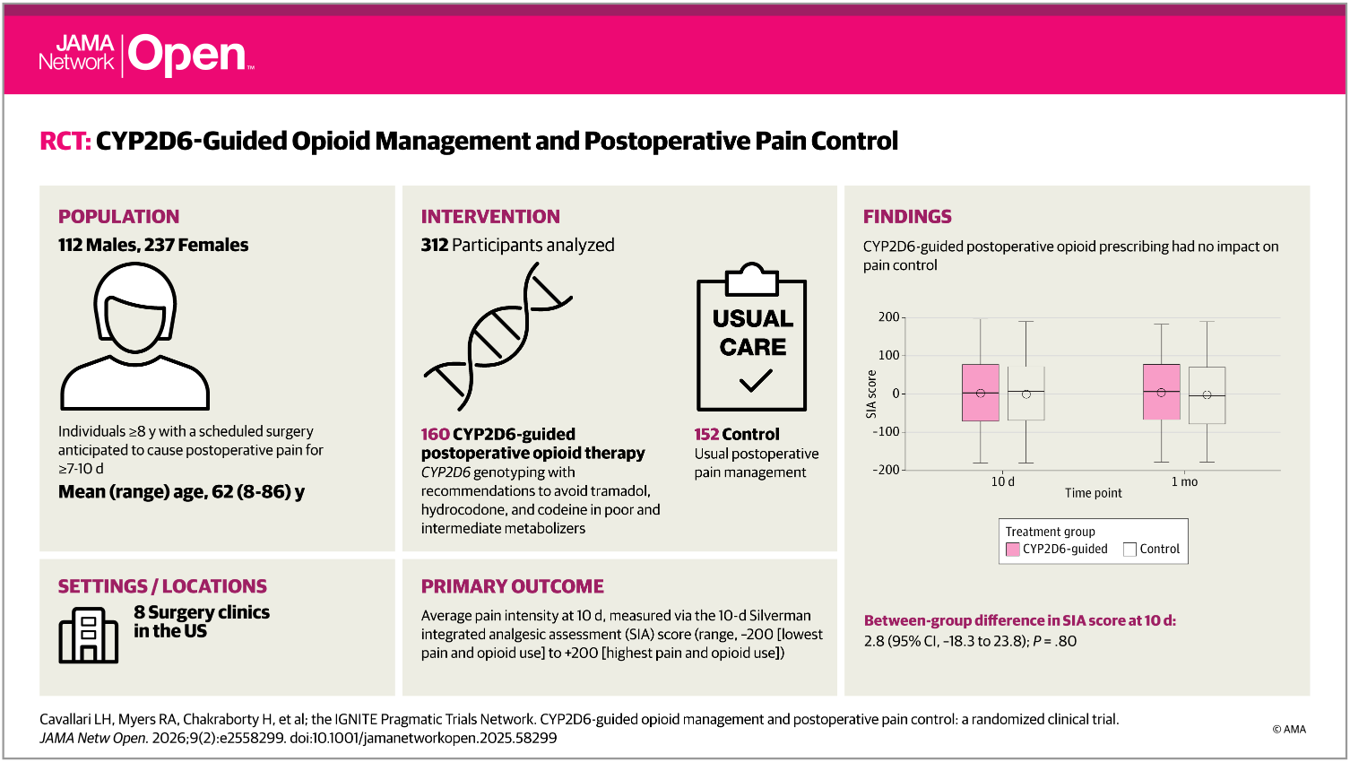
The ADOPT-PGx study examined the impact of genotype-guided opioid prescribing on postoperative pain management. Results from the study were recently published in JAMA Network Open, accompanied by an invited commentary reflecting on the findings and their implications for pharmacogenetics in clinical care.
ADOPT-PGx is a pragmatic, randomized clinical trial designed to evaluate whether CYP2D6-guided opioid prescribing improves pain outcomes following surgery compared with usual care. The study was conducted in real-world clinical settings to assess the feasibility and effectiveness of pharmacogenetic implementation at scale.
The primary outcome focused on postoperative pain control, with secondary outcomes examining prescribing patterns and opioid use. While genotype-guided prescribing influenced medication selection, the study found no significant improvement in pain outcomes, underscoring the complexity of acute pain as a multifactorial clinical phenotype.
The invited commentary places these findings in broader context, highlighting both the promise and current limitations of single-gene pharmacogenetic approaches for pain management and emphasizing the need for more integrated strategies to support personalized care.
Read the publication here.
Read the invited commentary here.
Larisa H. Cavallari, PharmD1; Rachel A. Myers, PhD; Hrishikesh Chakraborty, DrPH
To address low participation in genetic testing, a team of researchers from the Medical University of South Carolina, led by Caitlin G. Allen, PhD, MPH, developed a 10-module training curriculum designed to teach community health workers (CHWs) how to share the importance of genetic testing with community members. Through focus groups, Dr. Allen and team worked with CHWs and clinicians to learn about their needs and preferences for genetics training materials. The virtual, 12-hour training, called Keeping Each other Engaged Program via IT (KEEP IT), was delivered to 26 CHWs. The full outcomes of the KEEP IT training sessions are anticipated to be published soon, and the team plans on expanding the training across four other Southern states in the U.S.
Read the full news release.
On March 21, 2024, the Food and Drug Administration (FDA) approved safety labeling changes for fluorouracil injection products. Revisions to the labeling note increased warning of severe toxicity in patients with dihydropyrimidine dehydrogenase (DPD) deficiency and encourages clinicians to discuss DPYD testing and associated risks with their patients. Additionally, a new subsection for pharmacogenomics was added to section 12 (Clinical Psychology). This effort was a collaboration between FDA’s Office of Generic Drugs and the Oncology Center of Excellence (OCE).
Read the full news post on the FDA website.
The GUARDD-US study aims to determine the impact of disclosing genetic of kidney failure among adults with African ancestry on blood pressure. The GUARDD-US study team celebrated surpassing their enrollment goal on September 30, 2023 after enrolling 6,754 participants. The last participant is expected to complete the follow-up period for the trial by May 2024.
The study is a prospective, multicenter, unblinded, two-arm randomized pragmatic clinical trial investigating the impact of apolipoprotein L1 (APOL1) genotyping in patients with self-reported African ancestry who have been diagnosed with hypertension.
The study’s primary goal is to determine the effect of participant and provider knowledge of a high-risk APOL1 genotype on change in systolic blood pressure from baseline to 3 months after randomization. Secondary outcomes include kidney disease testing and psycho-behavioral factors.
Participants were randomized in a 1:1 ratio to immediate versus delayed APOL1 genotype testing with the return of results participants and providers. A subset of the participants without high-risk APOL1 genotype were re-randomized to a genotype-guided approach to anti-hypertensive therapy versus usual care to determine the effect on three-month systolic blood pressure.
GUARDD-US was conducted across 11 relying sites and over 50 clinical practices in the United States.
Study results and primary manuscripts are anticipated to be released in late 2024.
More information about GUARDD-US can be found at https://clinicaltrials.gov/study/NCT04191824.