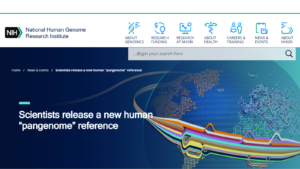
Scientists release a new human “pangenome” reference

Researchers have released a new high-quality collection of reference human genome sequences that captures substantially more diversity from different human populations than what was previously available. The work was led by the international Human Pangenome Reference Consortium, a group funded by the National Human Genome Research Institute (NHGRI), part of the National Institutes of Health.

The new “pangenome” reference includes genome sequences of 47 people, with the researchers pursuing the goal of increasing that number to 350 by mid-2024. With each person carrying a paired set of chromosomes, the current reference actually includes 94 distinct genome sequences, with a goal of reaching 700 distinct genome sequences by the completion of the project.

Read the full press release on the NHGRI website.

NASEM Report Says Researchers Need to Rethink and Justify How and Why Race, Ethnicity, and Ancestry Labels Are Used in Genetics and Genomics Research

Researchers and scientists who utilize genetic and genomic data should rethink and justify how and why they use race, ethnicity, and ancestry labels in their work, says a new National Academies of Sciences, Engineering, and Medicine (NASEM) report.
The report says researchers should not use race as a proxy for describing human genetic variation. Race is a social concept, but it is often used in genomics and genetics research as a surrogate for describing human genetic differences, which is misleading, inaccurate, and harmful. To improve genomics research, the report presents a new framework and decision tree to help researchers choose descriptors and labels that are most appropriate for their study.

From the beginning of genetics and genomics research, researchers have used “population descriptors” as a shorthand for capturing the complex patterns of human genetic variation across the globe. For example, these descriptors can identify groups based on nationality, such as French; geography, such as North American; or ethnicity, such as Hispanic. But human genetic differences are distributed in complex ways that do not necessarily align with a single descriptor.

Read the full news release and report on the NASEM website.


PGx ECHO Program

The University of Minnesota College of Pharmacy invites all actively practicing clinicians to join their Pharmacogenomics (PGx) ECHO project. PGx ECHO aims to improve health professionals’ confidence in using PGx in patient care by providing case-based education and consultation through telementoring. Every month, clinicians from across the nation seek PGx advice regarding real clinical cases. PGx ECHO is modeled on the all-teach-all-learn principle and encourages interactive and engaging discussion between attendees and facilitators.

The University of Minnesota works with colleagues at Children’s MN, Ferris State University, M Health Fairview, Manchester University, North Dakota State University, South Dakota State University, and Sanford Health to coordinate and facilitate the monthly sessions. PGx ECHO meets the third Friday of every month over the lunch hour. For past ECHO cases and topics, and a schedule of upcoming cases, please visit the PGx ECHO website.

If you are interested in joining, please use this link to register.

PGx ECHO is for practicing clinicians with direct patient care responsibilities. Student learners are welcome to join.

If you would like to present a case or have any questions, please contact pgxecho@umn.edu.

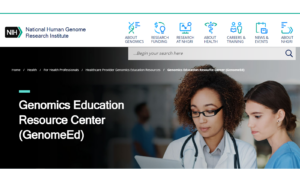
NIH Genetics/Genomics Competency Center is refreshed and renamed to GenomeEd

The National Human Genome Research Institute’s Genetics/Genomics Competency Center (G2C2) has been a valued resource for healthcare provider educators and learners alike for over 10 years. The resource, now called GenomeEd, has recently undergone a refresh to make it easier for educators and current practitioners to find high-quality resources for group instruction or self-directed learning.

Learn more on the National Human Genome Research Institute website.

Implementing a Pragmatic Clinical Trial to Tailor Opioids for Acute Pain on behalf of the IGNITE ADOPT PGx Investigators

Larisa H CavallariEmily CicaliKristin Wiisanen, Roger B FillingimHrishikesh ChakrabortyRachel A MyersKathryn V BlakeBolanle AsiyanbolaJordan F BayeWesley H BronsonKelsey J CookErica N ElwoodChancellor F GrayYan Gong, Lindsay HinesJoseph KannryNatalie Kucher, Sheryl LynchKhoa A NguyenAniwaa Owusu ObengVictoria M Pratt, Hernan A PrietoMichelle RamosAzita Sadeghpour, Rajbir SinghMarc RosenmanPetr StarostikCameron D ThomasEmma TillmanPaul R Dexter, Carol R Horowitz, Lori A Orlando, Josh F PetersonTodd C SkaarSara L Van DriestSimona Volpi, Deepak VooraHari K ParvataneniJulie A JohnsonThe IGNITE Pragmatic Trials Network

WHO’s Science Council Launches Report Calling for Equitable Expansion of Genomics

The World Health Organization (WHO) Science Council of experts has issued its first report, on accelerating access to genomics for global health. The report argues that it is not justifiable ethically or scientifically for less-resourced countries to gain access to such technologies long after rich countries do.

The field of genomics uses methods from biochemistry, genetics, and molecular biology to understand and use biological information in DNA and RNA, with benefits for medicine and public health – especially during the COVID-19 pandemic – as well as agriculture, biological research and more. The report calls for expanding access to genomic technologies, particularly in low- and middle-income countries (LMICs), by addressing shortfalls in financing, laboratory infrastructure, materials, and highly trained personnel.

Read the full article and the Science Council’s report on the WHO website.

NHGRI Concludes Genomics and the Media Seminar Series

In June, the National Human Genome Research Institute (NHGRI) concluded the seven-part virtual “Genomics and the Media Seminar Series.” The series featured trailblazers in science communication. Each speaker, an expert in communicating about genomics across media – including radio, podcasting, writing, speaking, publishing, and everything in between – was provided the opportunity to talk about what it is like to cover genomics today, such as the special challenges in reporting about such a quickly growing scientific field, and how that has changed since the Human Genome Project. The series aimed to demonstrate the various approaches for communicating about genomics as well as the unique challenges and opportunities each medium can bring. The seminars attracted an average of 150 live attendees and each included a robust moderated question-and-answer session. The recordings of all seven seminars are available for viewing on GenomeTV.

Learn more and watch the lectures on the NHGRI website.