
 GMKB
GMKB- PMID: 35698903
- DOI: 10.2217/pgs-2022-0027
- Article on PubMed.gov
Clinical Pharmacogenetics Implementation Consortium Guideline for CYP2C19 Genotype and Clopidogrel Therapy: 2022 Update
- PMID: 35034351
- DOI: 10.1002/cpt.2526
- Article on PubMed.gov
NHGRI Releases New and Improved Talking Glossary of Genomic and Genetic Terms
 On National DNA Day (April 25) this year, the National Human Genome Research Institute (NHGRI) released a fully revamped version of its popular talking glossary, which included a new name: the Talking Glossary of Genomic and Genetic Terms. First launched in 1998, the talking glossary is one of the most visited sites on genome.gov. Some of the talking glossary’s terms receive over 70,000 views per month. This resource is filled with definitions, audio recordings, and illustrations for hundreds of terms. It is one of the premier educational resources offered by NHGRI, and it aims to help users better understand the basics of genomics and genetics.
Read the full article on the NHGRI website.
Researchers Generate the First Complete, Gapless Sequence of a Human Genome
Researchers Generate the First Complete, Gapless Sequence of a Human Genome
Scientists have published the first complete, gapless sequence of a human genome, two decades after the Human Genome Project produced the first draft human genome sequence.
According to researchers, having a complete, gap-free sequence of the roughly 3 billion bases (or “letters”) in our DNA is critical for understanding the full spectrum of human genomic variation and for understanding the genetic contributions to certain diseases. The work was done by the Telomere to Telomere (T2T) consortium, which included leadership from researchers at the National Human Genome Research Institute (NHGRI), part of the National Institutes of Health; University of California, Santa Cruz; and University of Washington, Seattle. NHGRI was the primary funder for the study.
Publication Available on the Design and Rationale of GUARDD-US
 Design and rationale of GUARDD-US: A pragmatic, randomized trial of genetic testing for APOL1 and pharmacogenomic predictors of antihypertensive efficacy in patients with hypertension
Abstract
Rationale and objective: APOL1 risk alleles are associated with increased cardiovascular and chronic kidney disease (CKD) risk. It is unknown whether knowledge of APOL1 risk status motivates patients and providers to attain recommended blood pressure (BP) targets to reduce cardiovascular disease.
Study design: Multicenter, pragmatic, randomized controlled clinical trial.
Setting and participants: 6650 individuals with African ancestry and hypertension from 13 health systems.
Intervention: APOL1 genotyping with clinical decision support (CDS) results are returned to participants and providers immediately (intervention) or at 6 months (control). A subset of participants are re-randomized to pharmacogenomic testing for relevant antihypertensive medications (pharmacogenomic sub-study). CDS alerts encourage appropriate CKD screening and antihypertensive agent use.
Outcomes: Blood pressure and surveys are assessed at baseline, 3 and 6 months. The primary outcome is change in systolic BP from enrollment to 3 months in individuals with two APOL1 risk alleles. Secondary outcomes include new diagnoses of CKD, systolic blood pressure at 6 months, diastolic BP, and survey results. The pharmacogenomic sub-study will evaluate the relationship of pharmacogenomic genotype and change in systolic BP between baseline and 3 months.
Results: To date, the trial has enrolled 3423 participants.
Conclusions: The effect of patient and provider knowledge of APOL1 genotype on systolic blood pressure has not been well-studied. GUARDD-US addresses whether blood pressure improves when patients and providers have this information. GUARDD-US provides a CDS framework for primary care and specialty clinics to incorporate APOL1 genetic risk and pharmacogenomic prescribing in the electronic health record.
Cost-effectiveness of exome and genome sequencing for children with rare and undiagnosed conditions
- PMID: 35396982
- DOI: 10.1016/j.gim.2022.03.005
Real-world economic evaluation of prospective rapid whole-genome sequencing compared to a matched retrospective cohort of critically ill pediatric patients in the United States
- PMID: 35436997
- DOI: 10.1038/s41397-022-00277-5
Design and rationale of GUARDD-US: A pragmatic, randomized trial of genetic testing for APOL1 and pharmacogenomic predictors of antihypertensive efficacy in patients with hypertension
- PMID: 35660539
- DOI: 10.1016/j.cct.2022.106813
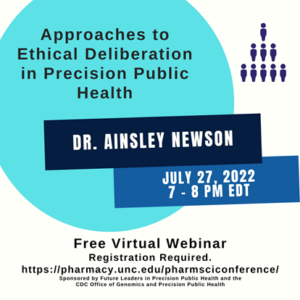
July 27: Virtual Precision Public Health Webinar
Attend a free virtual precision public health webinar on July 27 from 7:00-8:00pm ET/July 28 from 9-10 am AEST. During this time, Dr. Ainsley Newson, Professor of Bioethics at the University of Sydney, will present “Approaches to Ethical Deliberation in Precision Public Health,” which will examine how bioethics scholarship should approach issues related to the use of genetics and genomics in precision public health and the appropriate implementation of these technologies.
This webinar will be held on Zoom. Registration is required.