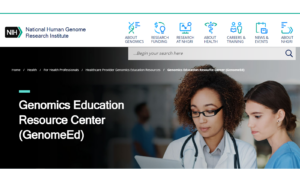
NIH Genetics/Genomics Competency Center is refreshed and renamed to GenomeEd

The National Human Genome Research Institute’s Genetics/Genomics Competency Center (G2C2) has been a valued resource for healthcare provider educators and learners alike for over 10 years. The resource, now called GenomeEd, has recently undergone a refresh to make it easier for educators and current practitioners to find high-quality resources for group instruction or self-directed learning.

Learn more on the National Human Genome Research Institute website.

Parental Guidance Suggested: Engaging Parents as Partners in Research Studies of Genomic Screening for a Pediatric Population

Sabrina N. Powell, Grace Byfield, Ashley Bennetone, Annabelle M. Frantz, Langston K. Harrison, Erin R. James-Crook, Heather Osborne, Thomas H. Owens, Jonathan L. Shaw, Julianne O’Daniel, and Laura V. Milko

Recent advances in genomic sequencing and genomic medicine are reshaping the landscape of clinical care. As a screening modality, genetic sequencing has the potential to dramatically expand the clinical utility of newborn screening (NBS), though significant barriers remain regarding ethical, legal, and social implications (ELSI) and technical and evidentiary challenges. Stakeholder-informed implementation research is poised to grapple with many of these barriers, and parents are crucial stakeholders in this process. We describe the formation and activities of a Community Research Board (CRB) composed of parents with diverse backgrounds assembled to participate in an ongoing research partnership with genomic and public health researchers at the University of North Carolina. The mission of the CRB is to provide insight into parental perspectives regarding the prospect of adding genomic sequencing to NBS and collaboratively develop strategies to ensure its equitable uptake. We describe how these contributions can improve the accessibility of research and recruitment methods and promote trust and inclusivity within diverse communities to maximize the societal benefit of population genomic screening in healthy children.

Read the full article in Frontiers in Genetics.

Keywords: genomic sequencing, newborn screening, community research board, engaging parents, stakeholders, public health, equity, accessibility
Effect of Pharmacogenomic Testing for Drug-Gene Interactions on Medication Selection and Remission of Symptoms in Major Depressive Disorder: The PRIME Care Randomized Clinical Trial

David W OslinKevin G LynchMei-Chiung Shih, Erin P IngramLaura O Wray, Sara R Chapman, Henry R KranzlerJoel Gelernter, Jeffrey M PyneAnnjanette StoneScott L DuVallLisa Soleymani LehmannMichael E ThasePRIME Care Research GroupMuhammad AslamSteven L BatkiJames M BjorkFrederic C BlowLisa A BrennerPeijun ChenShivan DesaiEric W DieperinkScott C Fears, Matthew A FullerCourtney S GoodmanDavid P Graham, Gretchen L HaasMark B Hamner, Amy W HelstromRobin A Hurley, Michael S IcardiGeorge J JurjusAmy M KilbourneJulie Kreyenbuhl, Daniel J LacheSteven P LieskeJulie A LynchLaurence J MeyerCristina MontalvoSumitra MuralidharMichael J OstacherGayla Y PaschallPaul N PfeifferSusana PrietoRonald M PrzygodzkiMohini RanganathanMercedes M Rodriguez-SuarezHannah RoggenkampSteven A SchichmanJohn S Schneeweis, Joseph A SimonettiStuart R SteinhauerTrisha SuppesMaria A UmbertJason L VassyDeepak VooraIlse R WiechersAmanda E Wood

A pragmatic implementation research study for In Our DNA SC: a protocol to identify multi-level factors that support the implementation of a population-wide genomic screening initiative in diverse populations

Caitlin G. Allen, Daniel P. Judge, Elissa Levin, Katherine Sterba, Kelly Hunt, Paula S. Ramos, Cathy Melvin, Karen Wager, Kenneth Catchpole, Catherine Clinton, Marvella Ford, Lori L. McMahon, and Leslie Lenert

DOI: 10.1186/s43058-022-00286-2

Lessons Learned from the Pilot Phase of a Population-Wide Genomic Screening Program: Building the Base to Reach a Diverse Cohort of 100,000 Participants

Caitlin G. Allen, Leslie Lenert, Kelly Hunt, Amy Jackson, Elissa Levin, Catherine Clinton, John T. Clark, Kelli Garrison, Sam Gallegos, Karen Wager, Wenjun He, Katherine Sterba, Paula S. Ramos, Cathy Melvin, Marvella Ford, Kenneth Catchpole, Lori McMahon, and Daniel P. Judge

DOI: 10.3390/jpm12081228

Implementing a Pragmatic Clinical Trial to Tailor Opioids for Acute Pain on behalf of the IGNITE ADOPT PGx Investigators

Larisa H CavallariEmily CicaliKristin Wiisanen, Roger B FillingimHrishikesh ChakrabortyRachel A MyersKathryn V BlakeBolanle AsiyanbolaJordan F BayeWesley H BronsonKelsey J CookErica N ElwoodChancellor F GrayYan Gong, Lindsay HinesJoseph KannryNatalie Kucher, Sheryl LynchKhoa A NguyenAniwaa Owusu ObengVictoria M Pratt, Hernan A PrietoMichelle RamosAzita Sadeghpour, Rajbir SinghMarc RosenmanPetr StarostikCameron D ThomasEmma TillmanPaul R Dexter, Carol R Horowitz, Lori A Orlando, Josh F PetersonTodd C SkaarSara L Van DriestSimona Volpi, Deepak VooraHari K ParvataneniJulie A JohnsonThe IGNITE Pragmatic Trials Network

WHO’s Science Council Launches Report Calling for Equitable Expansion of Genomics

The World Health Organization (WHO) Science Council of experts has issued its first report, on accelerating access to genomics for global health. The report argues that it is not justifiable ethically or scientifically for less-resourced countries to gain access to such technologies long after rich countries do.

The field of genomics uses methods from biochemistry, genetics, and molecular biology to understand and use biological information in DNA and RNA, with benefits for medicine and public health – especially during the COVID-19 pandemic – as well as agriculture, biological research and more. The report calls for expanding access to genomic technologies, particularly in low- and middle-income countries (LMICs), by addressing shortfalls in financing, laboratory infrastructure, materials, and highly trained personnel.

Read the full article and the Science Council’s report on the WHO website.

NHGRI Concludes Genomics and the Media Seminar Series

In June, the National Human Genome Research Institute (NHGRI) concluded the seven-part virtual “Genomics and the Media Seminar Series.” The series featured trailblazers in science communication. Each speaker, an expert in communicating about genomics across media – including radio, podcasting, writing, speaking, publishing, and everything in between – was provided the opportunity to talk about what it is like to cover genomics today, such as the special challenges in reporting about such a quickly growing scientific field, and how that has changed since the Human Genome Project. The series aimed to demonstrate the various approaches for communicating about genomics as well as the unique challenges and opportunities each medium can bring. The seminars attracted an average of 150 live attendees and each included a robust moderated question-and-answer session. The recordings of all seven seminars are available for viewing on GenomeTV.

Learn more and watch the lectures on the NHGRI website.

Medical Genomics in Underrepresented Populations from Latin America to the Pacific

On June 13, Dr. Andrés Moreno Estrada delivered a lecture for the Genomics and Health Disparities Lecture Series, co-sponsored by institutes in the National Institutes of Health (NIH) and the Food and Drug Administration (FDA).

The Genomics and Health Disparities Lecture Series was formed to enhance opportunities for dialogue about how innovations in genomics research and technology can impact health disparities. Topics range from basic science to translational research.

View Dr. Moreno’s session and other recordings on the NHGRI’s website.