Challenges, Insights and Outcomes of a Clinically Integrated Multi-omic Rare Disease Program

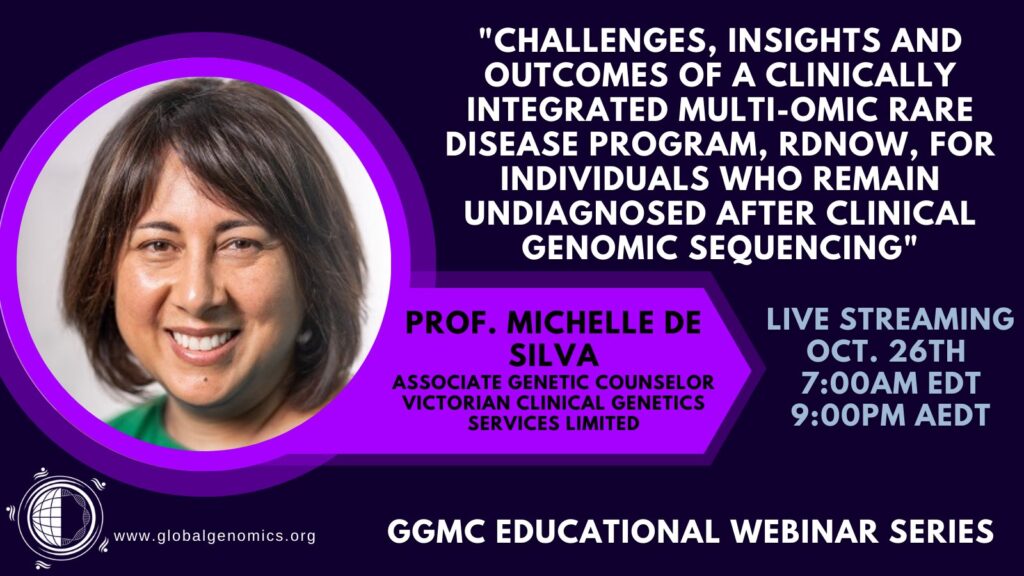
Challenges, Insights and Outcomes of a Clinically Integrated Multi-omic Rare Disease Program, RDNow, for Individuals Who Remain Undiagnosed After Clinical Genomic Sequencing

Thursday, October 26 | 7 a.m. ET | Online

Speaker: Dr. Michelle de Silva

Michelle is an associate genetic counselor with a PhD in molecular genetics. She is an experienced medical researcher and has managed several multidisciplinary research centres at the University of Melbourne, while also working as the program manager of the Rare Disease Flagship and RDNow Program at Murdoch Children’s Research Institute in Melbourne.

To learn more and register, visit the GGMC Educational Webinar Series webpage.

Please note: Registration is required for this webinar.

Clinical Genomics: Ending Diagnostic Odysseys & Enhancing Equity in Patient Care Webinar

Thursday, September 22 | 1-3 p.m. ET | Virtual

The White House Office of Science and Technology Policy, in close partnership with the National Institute of Child Health and Human Development, is hosting a webinar on clinical genomics. This event will engage a variety of stakeholder groups, with significant representation from patients and patient organizations, as well as professionals from the genetics community, including genetic counselors, medical geneticists, and researchers along with decision makers from state Medicaid and private insurance plans.

Visit the Office of Science and Technology Policy’s website for more details and to register for this virtual event.

Parental Guidance Suggested: Engaging Parents as Partners in Research Studies of Genomic Screening for a Pediatric Population

Sabrina N. Powell, Grace Byfield, Ashley Bennetone, Annabelle M. Frantz, Langston K. Harrison, Erin R. James-Crook, Heather Osborne, Thomas H. Owens, Jonathan L. Shaw, Julianne O’Daniel, and Laura V. Milko

Recent advances in genomic sequencing and genomic medicine are reshaping the landscape of clinical care. As a screening modality, genetic sequencing has the potential to dramatically expand the clinical utility of newborn screening (NBS), though significant barriers remain regarding ethical, legal, and social implications (ELSI) and technical and evidentiary challenges. Stakeholder-informed implementation research is poised to grapple with many of these barriers, and parents are crucial stakeholders in this process. We describe the formation and activities of a Community Research Board (CRB) composed of parents with diverse backgrounds assembled to participate in an ongoing research partnership with genomic and public health researchers at the University of North Carolina. The mission of the CRB is to provide insight into parental perspectives regarding the prospect of adding genomic sequencing to NBS and collaboratively develop strategies to ensure its equitable uptake. We describe how these contributions can improve the accessibility of research and recruitment methods and promote trust and inclusivity within diverse communities to maximize the societal benefit of population genomic screening in healthy children.

Read the full article in Frontiers in Genetics.

Keywords: genomic sequencing, newborn screening, community research board, engaging parents, stakeholders, public health, equity, accessibility