Submit Ideas for Opportunity to Speak at Virtual NHGRI Symposium

The National Human Genome Research Institute (NHGRI) invites you to submit your ideas for an opportunity to be one of six speakers at its upcoming virtual symposium, “Irreducible Subjects: Disability and Genomics in the Past, Present and Future” October 6-7, 2022

The virtual symposium will address historical and present-day constructions of disability and ableism, with a focus on the history and lived experiences of people with disabilities in the context of genetics and genomics.

Through an open call for presentations, the event aims to develop a fuller account of the lives and experiences of people with disabilities. Conversations will link disability rights to wider NIH discussions and around inclusivity, intersectionality, equity, and social justice.

Deadline for submissions is June 30, 2022. Email submissions to nhgrihistory@mail.nih.gov.

View the call for papers.

June 28: IHCC Educational Webinar

Register for the upcoming International HundredK+ Cohorts Consortium (IHCC) webinar presented on Tuesday, June 28, 2022 at 8:00am ET/1:30pm UTC. Guest speaker Dr. Reza Malekzadeh will speak on “Using the IHCC to Prevent Premature Death Around the Globe.”

Registration is required.

Dr. Malekzadeh is a Professor at the Digestive Disease Research Institute of Tehran in Iran. He founded the institute in 2000 and has since expanded it further. His main field of interest is digestive oncology and chronic disease with a special interest in prevention of NCD. He has also supervised and conducted several epidemiological and clinical studies and even established the first large-scale cohort study in the Middle East and North Africa (Golestan Cohort Study).

Dr. Malekzadeh is currently a member of 20 large-scale international collaborative studies. Since cardiovascular diseases (CVD), cancers, and other chronic diseases are the leading causes of morbidity and mortality in Iran, he is interested in investigating the environmental and genetic risk factors of chronic diseases as well as metabolic syndrome. For this reason, he has since started the Pars (Southern Iran) and Golestan (Northern Iran) Cohort Studies and several other studies including clinical trials, case control and ecologic studies, collecting detailed data and biological samples from cohort subjects and patients with cancer, CVD, chronic liver disease especially HBV, NAFLD/NASH.

He’s also established a pragmatic randomized control trial of healthy lifestyle and polypill for prevention of CVD and other NCD nested within the Golestan and pars cohort as well as the Persian Cohort, which includes all seven ethnicities of Iran with 200,000-sample size from 20 different provinces.

To learn more about the series, the upcoming webinar, our guest speaker, and to register for this event, please visit the IHCC Educational Webinar Series webpage.

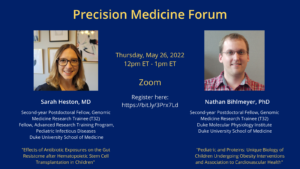
May 26: Duke Precision Medicine Forum: Sarah Heston, MD and Nathan Bihlmeyer, PhD

Join Sarah Heston, MD and Nathan Bihlmeyer, PhD on May 26 from 12pm ET – 1pm ET for a discussion on the “Effects of Antibiotic Exposures on the Gut Resistome after Hematopoietic Stem Cell Transplantation in Children” and “Pediatric and Proteins: Unique Biology of Children Undergoing Obesity Interventions and Association to Cardiovascular Health.” Registration is required.

May 11, 18, and 25: Machine Learning Tools for Clinical Researchers: A Pragmatic Approach Series

Machine Learning Tools for Clinical Researchers: A Pragmatic Approach Series

Join the UNC Core Center for Clinical Research (CCCR) and Program for Precision Medicine in Health Care (PPMH) for “Machine Learning Tools for Clinical Researchers: A Pragmatic Approach Series,” a free virtual seminar series on May 11 from 9:30am ET – 11:30am ET and May 18 and 25 from 1pm ET – 3pm ET. This series will provide a foundation of knowledge regarding the use of machine learning tools in clinical questions, define the strengths and limitations of these methods, explore real-world examples of applied machine learning methodology in clinical research, and elucidate how machine learning can be used to advance precision medicine research.

Are you a clinician with an idea for how patient care could be improved with computational decision support tools? Be sure to attend the May 25 session. Pitch your idea (5-10 minute overview) to assembled machine learning experts. Receive guidance and compete for funding from PPMH for analytical support to develop your project. Email precisionmedicine@med.unc.edu for pitch guidelines.

Click here to register and for more information.

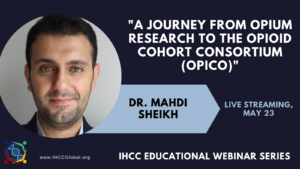
May 23: IHCC Educational Webinar

Register for the upcoming International HundredK+ Cohorts Consortium(IHCC) Educational Webinar on May 23, 2022 at 9am ET/1pm GMT.  Our guest speaker Dr. Mahdi Sheikh will present his talk on “A journey from opium research to the opioid cohort consortium (OPICO)”. To learn more and to register, please visit the Educational Webinar page on the IHCC Website.
Registration is required. Register here.

May 24-25: Translational Science in Drug Development: Surrogate Endpoints, Biomarkers, and More

The Duke Margolis Center for Health Policy, in collaboration with the FDA, is convening a virtual two-day workshop May 24-25 from 12pm ET – 4pm ET, titled “Translational Science in Drug Development: Surrogate Endpoints, Biomarkers, and More.” This workshop will be of key relevance to a wide array of faculty, staff, and students working in basic, translational, and clinical sciences that support the development of therapeutics.

Register here: https://healthpolicy.duke.edu/events/translational-science-drug-development-surrogate-endpoints-biomarkers-and-more

For any questions about the workshop, please feel free to reach out to Erin Soule or Nancy Allen Lapointe.

Call for Applications: Joint Postdoctoral Fellowship in Clinical Ethics and the ELSI of Precision Medicine

The University of North Carolina (UNC) Center for Genomics and Society (CGS) and the Center for Bioethics (C:B), together with the Program for Precision Medicine in Health Care (PPMH), announce a joint postdoctoral position in clinical ethics and the ethical, legal, and social implications (ELSI) of precision medicine. Through this partnership, we are expanding the original CGS postdoctoral training program to include an emphasis on practical clinical ethics and attention to precision medicine. We are pleased to invite applications from individuals who are committed to interdisciplinary collaboration and research, and who have specific interests in these areas.

This two-year fellowship will begin in September 2022. The fellowship allows time for research, training, and publications. Fellows will have the opportunity to collaborate with CGS, C:B, and PPMH faculty in the School of Medicine on selected projects in bioethics. They will also have the opportunity to participate in the Clinical Ethics Service at UNC Hospitals. With the assistance of a mentor, fellows will design an individual program tailored to their particular goals, interests, and background. Fellows may use the resources of CGS, C:B, and/or PPMH to develop projects on various topics relevant to clinical ethics and ELSI, as well as projects that highlight current PPMH interests, such as: use of genetics for screening healthy populations of adults and children; use of genomic information and family history in electronic health records; engagement of diverse populations in genomics and precision medicine; or design of precision medicine research.

Fellows will have access to a wide range of activities and opportunities within the CGS, C:B, and the PPMH, including:

  • Regular seminars, presentations, and discussions with leaders in the field
  • Bioethics mentorship
  • Professional development training
  • Teaching opportunities (commensurate with experience and background)
  • Clinical ethics consultation training in UNC Hospitals
  • Independent and collaborative research
  • Publication opportunities (as a co-author, lead author, or solo author)
  • Grant-writing opportunities
  • Conference presentations

Qualifications:

  • Candidates should have a strong interest in clinical ethics, precision medicine, and/or ELSI research, and have recently completed a doctoral degree (PhD, JD, MD) before beginning the program.
  • We welcome individuals from a variety of disciplines in the social and behavioral sciences, genetics or other basic sciences, epidemiology, nursing, medicine, law, philosophy, or public health.

Salary/Benefits:

  • Salary is commensurate with experience and similar to rates offered by the NIH
  • Health insurance
  • A modest discretionary fund for travel

How to apply:

Review of applications will begin immediately with a deadline of May 31, 2022.  Candidates may apply via PeopleAdmin: https://unc.peopleadmin.com/postings/221929.

Complete applications require the following materials:

  • Cover letter
  • Personal statement in support of your application (2 pages, maximum)
  • CV
  • Three letters of reference
  • Writing sample (published or unpublished for which you were the lead or solo author)

For more information on this fellowship position, please contact Kriste Kuczynski, Program Manager of the Center for Genomics and Society.