 The Implementing GeNomics In practice (IGNITE) Pragmatic Clinical Trials Network’s GUARDD-US study has published their main outcomes paper of the pilot study, whose aim is to determine the effect of returning Apolipoprotein L1 (APOL1) genetic risk information to hypertensive African ancestry patients.
“Effects of Testing and Disclosing Ancestry-Specific Genetic Risk for Kidney Failure on Patients and Health Care Professionals,” was published in JAMA Network Open in March 2022.
Chronic kidney disease (CKD) affects 26 million US adults.1 Individuals of African ancestry have a higher risk of CKD and end-stage kidney disease compared to individuals with European ancestry owing to social determinants, clinical factors, and health system factors.1–3 Race and ethnicity are social constructs, but ancestry has some biological underpinnings. The high-risk genotypes in the APOL1 gene are found in 1 of 7 people of African ancestry.
Through the randomized clinical trial, 2050 patients of African ancestry with hypertension without chronic kidney disease in which genetic testing results were disclosed to patients and clinicians, patients with high-risk APOL1 genotypes had greater improvement in blood pressure from baseline and more lifestyle changes compared with patients with low-risk APOL1 genotypes or control patients.
“Disclosing APOL1 genetic testing results to patients of African ancestry with hypertension and their clinicians was associated with a greater reduction in systolic blood pressure, increased kidney disease screening and positive self-reported behavior changes (eg, taking blood pressure medications regularly) in those with genetic high risk,” said Carol Horowitz, MD, MPH, Professor of Population Health Science and Policy and Medicine at Icahn School of Medicine at Mount Sinai.
Researchers have found that disclosing these genetic testing results ultimately are a benefit to patients.
“These results suggest we are headed in the right direction. Genetic testing is a particularly sensitive issue for the African American community. African Americans have a higher risk of kidney disease development and progression. While race is a social construct, and this disparity is multifactorial and structural, ancestry has genetic components,” said Girish N. Nadkarni, MD, MPH, the Irene and Dr. Arthur M. Fishberg Professor of Medicine at Icahn Mount Sinai and the lead author of the study. “For many years, researchers have wondered whether reporting APOL1 genetic test results would help improve clinical management. This is the first pragmatic randomized clinical trial to test this out.”
“Additionally, we also show that trained laypersons can play a critical role in returning genetic results. This provides a new paradigm for return of genetic results especially in racial and ethnic minorities,” said Dr. Horowitz.
Read Full Publication Here
About IGNITE:
The Implementing GeNomics In practice (IGNITE) Pragmatic Clinical Trials Network is an NIH-funded network dedicated to advancing the implementation of genomics in healthcare.
With oversight from the National Human Genome Research Institute (NHGRI), the Network is comprised of a coordinating center at Duke University School Medicine and five clinical groups: Indiana University Health, Mount Sinai Health System, Duke University School of Medicine and Duke Health, University of Florida Health, and Vanderbilt University Medical Center. Additionally, the Network engages affiliate institutions across the country to encourage sharing of innovative research and best practices in genomic medicine implementation.
The IGNITE Network is conducting two genomic medicine pragmatic trials:
- ADOPT-PGx is an umbrella protocol for three pragmatic clinical trials investigating pharmacogenomics (PGx)-guided therapy for acute post-surgical pain, chronic pain, and depression. Pain and depression impact substantial proportions of the U.S. population, but finding safe, effective drug therapies remains challenging.
- GUARDD-US is a pragmatic clinical trial that aims to determine the effect of returning apolipoprotein L1 (APOL1) genetic risk information to hypertensive African ancestry patients and their primary care providers, with a focus on the control of systolic blood pressure.
These trials aim to help researchers and clinicians understand what to expect with the return of genetic information to patients and providers in real-world clinical settings. Learn more about IGNITE.


 GMKB
GMKB
 Today, April 25, is National DNA Day, which commemorates the completion of the Human Genome Project in 2003 and the discovery of DNA’s double-helical structure in 1953. Please join the NHGRI today from 1:00 PM to 2:00 PM ET for the virtual Louise M. Slaughter National DNA Day Lecture. This year’s speaker is Carter Clinton, Ph.D., postdoctoral scholar at Pennsylvania State University in the Departments of Anthropology and Biology. He will share his research, which looks to the past to improve our understanding of health disparities in African Americans today, with an emphasis on the importance of diversity in genomic databases. A moderated Q&A session will follow the presentation.
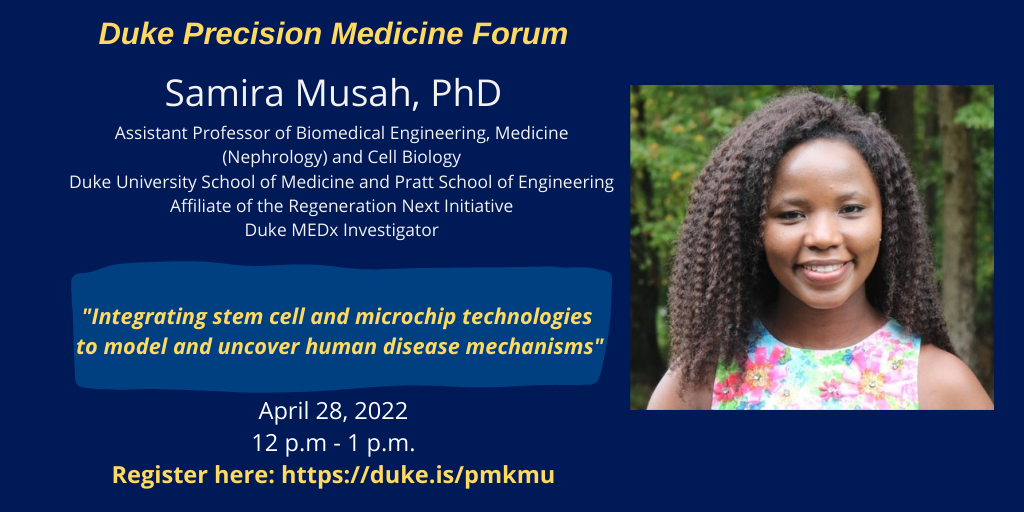 Join us for our next Duke Precision Medicine Forum on April 28, 2022 at 12 p.m. EST
  Public Health Genetics Week will take place May 23-27, 2022 and virtual events are free and open to the public.
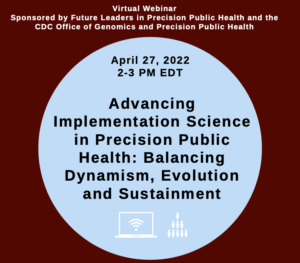 Virtual webinar with Dr. David Chambers from the National Cancer Institute
 Duke School of Medicine Genomic Seminar Series hosted by the Precision Genomics Collaboratory will take place Fri., April 22 from 12 – 1 p.m. EST on Zoom with Diana Bianchi, MD, from National Institute of Child Health and Development