
 GMKB
GMKBCaitlin G. Allen, Kelly J. Hunt, Lori L. McMahon, Clay Thornhill, Amy Jackson, John T. Clark, Katie Kirchoff, Kelli L. Garrison, Kimberly Foil, Libby Malphrus, Samantha Norman, Paula S. Ramos, Kelly Perritt, Caroline Brown, Leslie Lenert, and Daniel P. Judge.
Population Screening for Hereditary Hemochromatosis More than a Quarter Century After Gene Discovery – Current Status and the Path Forward
Population Screening for Hereditary Hemochromatosis More than a Quarter Century After Gene Discovery –
Current Status and the Path Forward
Thursday, February 15 | 1-2 p.m. ET | Virtual
Speakers: Paul C. Adams, MD, Professor, Division of Gastroenterology, Western University
Gail P. Jarvik, MD, PhD, Head and Professor, Division of Medical Genetics, University of Washington
Kris V. Kowdley, MD, FACP, FACG, AGAF, FAASLD, Director, Liver Institute Northwest
In this webinar, speakers will discuss how knowledge about hereditary hemochromatosis (HH) has evolved since the discovery of the HFE gene in 1997, current opportunities for clinical and public health action to prevent disease, and future research priorities to advance case detection and reduce clinical complications from HH.
To learn more and register, visit the CDC events page.
Please note: Registration is required for this webinar.
We Screen Newborns Don’t We? Progress in DNA-based Population Screening
Thursday, May 18 | 10 – 11 a.m. ET | Online
Rapid advances and decreasing costs of human genome sequencing technologies are accelerating the integration of genomics into clinical practice. Although genomic sequencing has demonstrated utility as an indication-based diagnostic tool for certain diseases, the full potential of DNA sequencing for population-level screening is yet to be realized. DNA-based population screening has enormous potential to identify people with underlying genetic predisposition to serious diseases such as cancer and heart disease, who represent 1–2% of the population. Early detection, disease prevention, and timely treatment can improve health outcomes and equity, and usher in a new era of precision public health.
Learn more and register for this webinar on the CDC Genomics and Precision Health website.
Speakers:
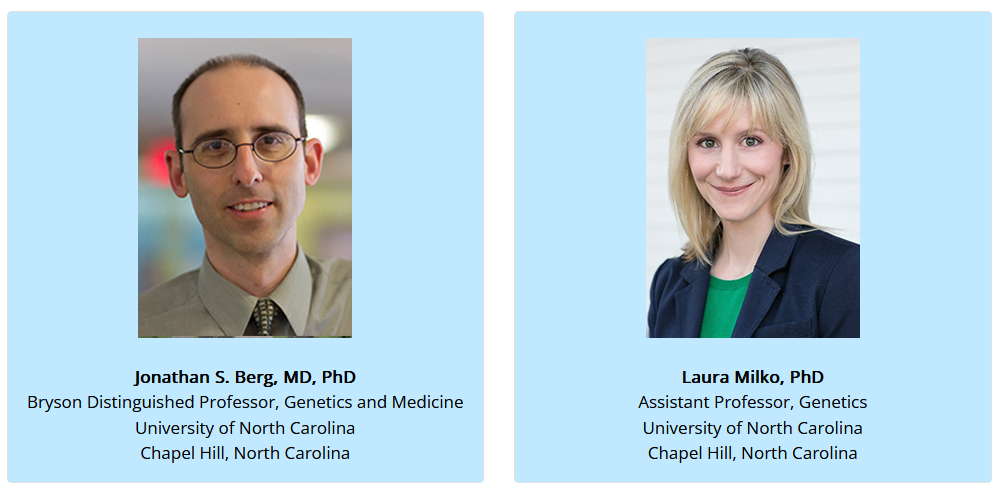
Jonathan S. Berg, MD, PhD
Bryson Distinguished Professor, Genetics and Medicine
University of North Carolina
Chapel Hill, North Carolina
Laura Milko, PhD
Assistant Professor, Genetics
University of North Carolina
Chapel Hill, North Carolina