
 GMKB
GMKBCaitlin G. Allen, Kelly J. Hunt, Lori L. McMahon, Clay Thornhill, Amy Jackson, John T. Clark, Katie Kirchoff, Kelli L. Garrison, Kimberly Foil, Libby Malphrus, Samantha Norman, Paula S. Ramos, Kelly Perritt, Caroline Brown, Leslie Lenert, and Daniel P. Judge.
Using the Canadian Partnership for Tomorrow’s Health to identify the Earliest Determinants of Disease Evolution and Aging
Thursday, March 30 | 9 a.m. ET | Online
This webinar, “Using the Canadian Partnership for Tomorrow’s Health to identify the Earliest Determinants of Disease Evolution and Aging,” will be presented by Dr. Philip Awadalla.
Professor Philip Awadalla is the National Scientific Director of the Canadian Partnership for Tomorrows Health (CanPath) and is the Executive Director of the Ontario Health Study (OHS). He is a Professor the Department of Molecular Genetics, and School of Public Health, at the University of Toronto. He is the Director of Computational Biology at the Ontario Institute of Cancer Research where he leads a research program studying the genomic and environmental determinants of early cancer evolution, aging, and studies fundamental processes shaping genomic variation.
Visit the IHCC Educational Webinar Series webpage to learn more and register.
Please note: Registration is required for this event.

Are We Ready for the Era of Genomic Medicine?
Friday, March 24 | 8 a.m. ET | Durham, NC & Online
Lori Orlando, MD, MHS, MMCI, Director of the Duke Precision Medicine Program and professor of medicine in the division of General Internal Medicine, will present at Medicine Grand Rounds on Fri., March 24, 2023. Dr. Orlando will present, “Are We Ready for the Era of Genomic Medicine?”, sharing why precision medicine has the potential to prevent disease, detect it early, and provide patients personalized interventions.
We Screen Newborns Don’t We? Progress in DNA-based Population Screening
Thursday, May 18 | 10 – 11 a.m. ET | Online
Rapid advances and decreasing costs of human genome sequencing technologies are accelerating the integration of genomics into clinical practice. Although genomic sequencing has demonstrated utility as an indication-based diagnostic tool for certain diseases, the full potential of DNA sequencing for population-level screening is yet to be realized. DNA-based population screening has enormous potential to identify people with underlying genetic predisposition to serious diseases such as cancer and heart disease, who represent 1–2% of the population. Early detection, disease prevention, and timely treatment can improve health outcomes and equity, and usher in a new era of precision public health.
Learn more and register for this webinar on the CDC Genomics and Precision Health website.
Speakers:
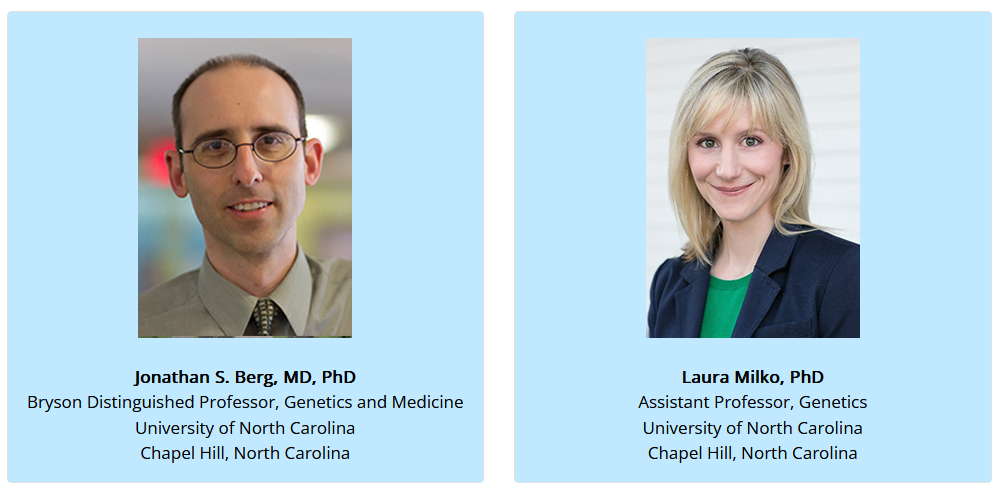
Jonathan S. Berg, MD, PhD
Bryson Distinguished Professor, Genetics and Medicine
University of North Carolina
Chapel Hill, North Carolina
Laura Milko, PhD
Assistant Professor, Genetics
University of North Carolina
Chapel Hill, North Carolina
From All of Us Research to All of Us in the Real World: Using the All of Us Research Program Data to Improve Population Health
From All of Us Research to All of Us in the Real World: Using the All of Us Research Program Data to Improve Population Health
Thursday, September 29 | 9:30-11 a.m., ET | Virtual | Free, registration required
Through a Data Use Agreement with the All of Us Research Program, scientists at the Centers for Disease Control and Prevention can now register to access and analyze All of Us Research Program Data through a cloud platform. In this seminar we will: 1) Review the All of Us Research Program study design and current status, 2) Discuss its potential for providing important population data to inform implementation of disease prevention and to reduce health disparities and 3) Provide a hands-on training session for scientists interested in accessing and analyzing All of Us Data.