
GUARDD-US APOL1 Genetic Testing Manuscript Published

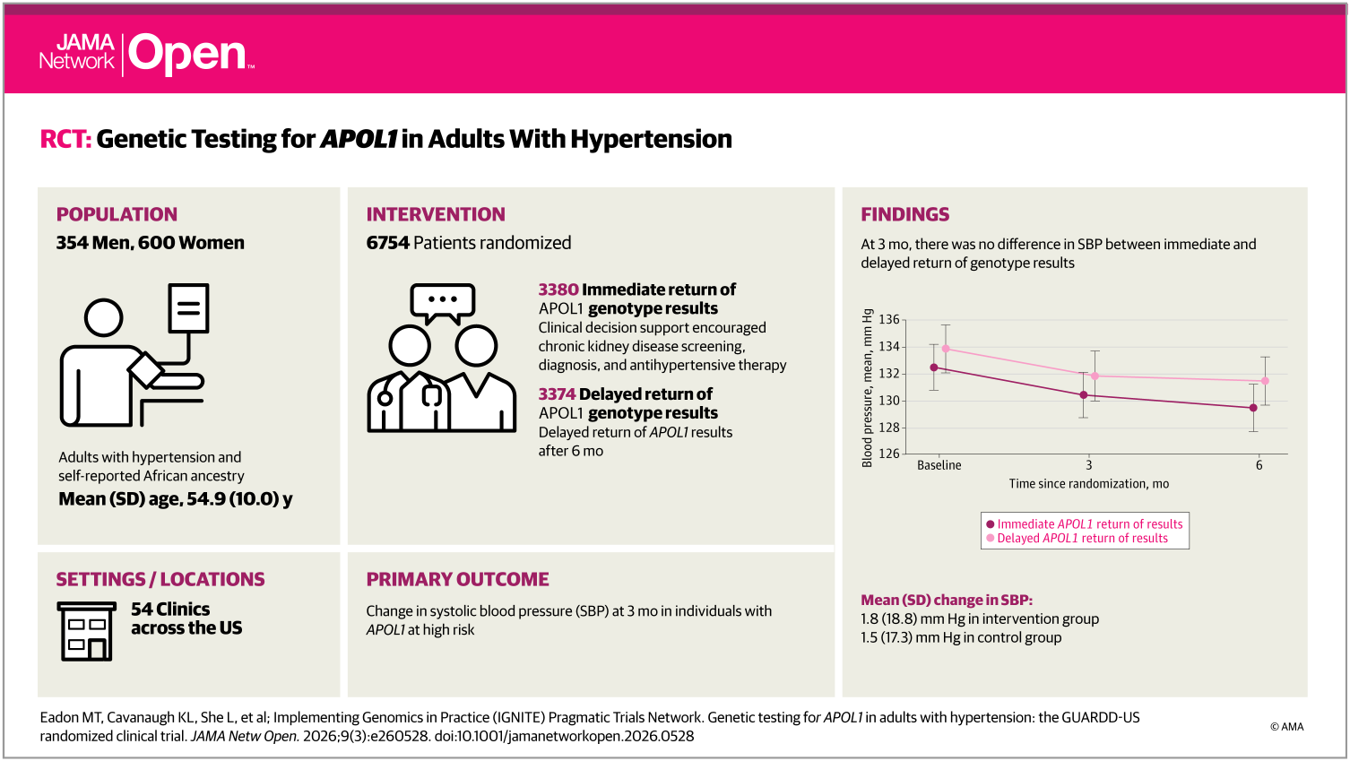
A new manuscript from the IGNITE Pragmatic Trials Network has been published in JAMA Network Open, describing the primary results of the GUARDD-US study.  GUARDD-US is a randomized controlled trial examining the impact of returning APOL1 genetic risk results to patients with hypertension and their clinicians. The study explores whether knowledge of genetic risk for kidney disease can influence blood pressure management and chronic kidney disease (CKD) screening in routine clinical care.  GUARDD-US enrolled more than 6,700 participants with self-reported African ancestry across 54 clinical sites in the United States, reflecting populations disproportionately affected by hypertension and CKD.

The primary outcome assessed changes in systolic blood pressure three months after randomization among individuals with APOL1 high-risk genotypes. Overall, immediate disclosure of genetic results was not associated with a significant reduction in systolic blood pressure compared with delayed disclosure. However, among participants who had uncontrolled blood pressure at baseline, those who received their genetic results experienced greater improvements in blood pressure control.

Importantly, returning APOL1 results also influenced clinical care beyond blood pressure management. Participants and clinicians who received immediate genetic results were more likely to pursue CKD screening and had higher rates of CKD diagnosis, highlighting the potential of genomic information to support earlier detection of kidney disease in at-risk populations.
Read the publication here.
ADOPT-PGx Acute Pain Manuscript Published with Invited Commentary

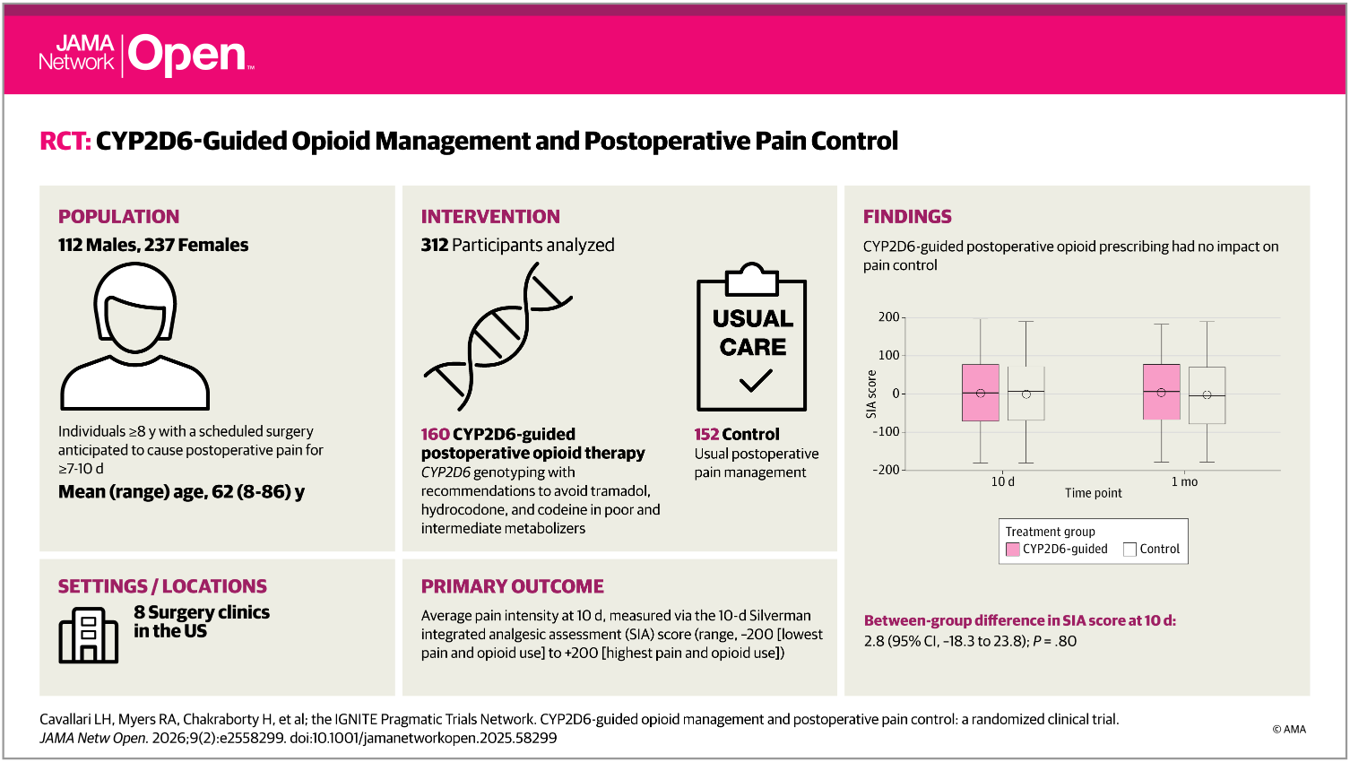
The ADOPT-PGx study examined the impact of genotype-guided opioid prescribing on postoperative pain management. Results from the study were recently published in JAMA Network Open, accompanied by an invited commentary reflecting on the findings and their implications for pharmacogenetics in clinical care.

ADOPT-PGx is a pragmatic, randomized clinical trial designed to evaluate whether CYP2D6-guided opioid prescribing improves pain outcomes following surgery compared with usual care. The study was conducted in real-world clinical settings to assess the feasibility and effectiveness of pharmacogenetic implementation at scale.

The primary outcome focused on postoperative pain control, with secondary outcomes examining prescribing patterns and opioid use. While genotype-guided prescribing influenced medication selection, the study found no significant improvement in pain outcomes, underscoring the complexity of acute pain as a multifactorial clinical phenotype.

The invited commentary places these findings in broader context, highlighting both the promise and current limitations of single-gene pharmacogenetic approaches for pain management and emphasizing the need for more integrated strategies to support personalized care.

Read the publication here.

Read the invited commentary here.

GUARDD-US Team Surpasses Enrollment Goal

The GUARDD-US study aims to determine the impact of disclosing genetic of kidney failure among adults with African ancestry on blood pressure. The GUARDD-US study team celebrated surpassing their enrollment goal on September 30, 2023 after enrolling 6,754 participants. The last participant is expected to complete the follow-up period for the trial by May 2024.

The study is a prospective, multicenter, unblinded, two-arm randomized pragmatic clinical trial investigating the impact of apolipoprotein L1 (APOL1) genotyping in patients with self-reported African ancestry who have been diagnosed with hypertension.

The study’s primary goal is to determine the effect of participant and provider knowledge of a high-risk APOL1 genotype on change in systolic blood pressure from baseline to 3 months after randomization. Secondary outcomes include kidney disease testing and psycho-behavioral factors.

Participants were randomized in a 1:1 ratio to immediate versus delayed APOL1 genotype testing with the return of results participants and providers.  A subset of the participants without high-risk APOL1 genotype were re-randomized to a genotype-guided approach to anti-hypertensive therapy versus usual care to determine the effect on three-month systolic blood pressure.

GUARDD-US was conducted across 11 relying sites and over 50 clinical practices in the United States.

Study results and primary manuscripts are anticipated to be released in late 2024.

More information about GUARDD-US can be found at https://clinicaltrials.gov/study/NCT04191824.

ADOPT PGx Team Reaches End-Of-Enrollment Milestone

ADOPT PGx recently celebrated reaching its participant enrollment milestone in September 2023 following the enrollment of 4,111 total participants. The last participant should complete the follow-up period for the trial by April 2024.

The primary goal of the study is to reduce depression symptoms and improve pain control in participants who are expected to process anti-depressant or pain medications faster or slower than normal as indicated by pharmacogenetic testing. Secondary goals include safety endpoints, changes in overall well-being, and differences in healthcare utilization.

The study is an umbrella protocol comprised of three separate arms: Acute Pain, including 1,602 participants, Chronic Pain, which enrolled 1,461 participants, and Depression, including 1,408 participants.

ADOPT PGx was conducted across five clinical groups representing nine different healthcare institutions in the United States.

Participants were randomized in a 1:1 ratio to immediate versus delayed pharmacogenetic testing and return of results to participants and providers.

Study results and primary manuscripts are expected to be completed in late 2024.

For more information about each of the trials, visit their trial page: Acute Pain, Chronic Pain, and Depression.