The Implementing GeNomics In practice (IGNITE) Pragmatic Clinical Trials Network is an NIH- funded network dedicated to supporting the implementation of genomics in healthcare.
Effective January 2022, Christina Wyatt, MD, associate professor of medicine (Nephrology) and Scott Palmer, MD, MHS, professor of medicine (Pulmonary, Allergy, and Critical Care Medicine) will replace Geoff Ginsburg, MD, PhD, as principal investigators for the IGNITE Pragmatic Clinical Trials Network coordinating center. Ginsburg recently was announced as the National Institutes of Health (NIH) Chief Medical and Scientific Officer for the All of Us research program.
Dr. Wyatt and Dr. Palmer will join Hrishikesh Chakraborty, DrPH, to serve as joint principal investigators for Duke University, who is the coordinating center for IGNITE.
The IGNITE network is comprised of five research sites, a coordinating center, a steering committee and working groups, with oversight from The National Human Genome Research Institute (NHGRI)
Two genome medicine studies are currently being facilitated through IGNITE:
- ADOPT PGx is an umbrella protocol for three pragmatic clinical trials investigating pharmacogenomics (PGx)-guided therapy for acute post-surgical pain, chronic pain, and depression. Pain and depression impact substantial proportions of the U.S. population, but finding safe, effective drug therapies remains challenging.
- GUARDD-US is a pragmatic clinical trial that aims to determine the effect of returning apolipoprotein L1 (APOL1) genetic risk information to hypertensive African ancestry patients and their primary care providers, with a focus on the control of systolic blood pressure.
These trials aim to help researchers and clinicians understand what to expect with the return of genetic information to patients and providers in real-world clinical settings.
Learn more about the IGNITE network here
Read recent publications on IGNITE here
About the PIs:
 Dr. Christina Wyatt is Associate Professor of Medicine and a core faculty member at the Duke Clinical Research Institute. She is a clinical-translational investigator at the intersection of HIV and kidney disease, including the role of genetic susceptibility attributed to variants in APOL1. Dr. Wyatt is currently the Clinical Core Director for a multidisciplinary P01 investigating the pathogenesis of HIV-related kidney disease, the PI of an ancillary study focused on kidney disease outcomes in the START clinical trial, and a co-investigator on 5 other NIH projects including a pragmatic clinical trial in young women using concomitant hormonal contraception and HIV pre-exposure prophylaxis. In addition to serving as PI or co-investigator on ancillary studies to the START and REPRIEVE clinical trials in people with HIV, Dr. Wyatt has experience as a member of Data and Safety Monitoring Boards and Clinical Endpoint Committees for large randomized clinical trials. She is an Associate Editor of Kidney International, the highest impact journal in nephrology, and a member of the Executive Committee for Kidney Disease | Improving Global Outcomes, the leading international guidelines organization in nephrology.
 Dr. Scott Palmer is Vice Chair of Research for the Department of Medicine and Therapeutic Area for MedicinePlus at the Duke Clinical Research Institute. Dr. Palmer is clinically trained in pulmonary and critical care medicine and completed advanced training in clinical research completing an MHS degree. He brings over 20 years of NIH funded research expertise including in translational human genetics and extensive experience leading successful multicenter consortium. He has led a high impact prospective, randomized, double-blind, placebo-controlled multicenter study to prevent CMV infection after lung transplant, published in Annals of Internal Medicine. He also led as PI and coordinated through the DCRI a phase 2 multicenter study of BMS-986020, a Lysophosphatidic Acid Receptor Antagonist, that established the proof-of-concept efficacy of this class of agents for the treatment of Idiopathic pulmonary fibrosis (IPF). He led administrative coordinating center (ACC) the multicenter Lung Regeneration and Repair Consortium (LRRC) and served as MPI for the Data Coordinating Center (DCC) of the Molecular Atlas of Lung Development (LungMAP), phase 1. He currently leads as overall study PI an ongoing 50-site IPF and ILD registry (IPF-PRO/ILD-PRO) that has enrolled over 1,500 patients with IPF or ILD. He also created and led as PI the first dedicated adult lung transplant NIAID Clinical Trials in Organ Transplant (CTOT) consortium. His notable genetic studies include the identification of rare protein coding variants in telomerase related genes that underlie the development of sporadic IPF.
 Dr. Hrishikesh Chakraborty is the Associate Professor in the Department of Biostatistics and Bioinformatics, Director of Pragmatic Clinical Trial Biostatistics at the Duke Clinical Research Institute, and Co-Director of the Quantitative Sciences Core for the Center for AIDS Research (CFAR) at Duke University. Currently, he is the principal investigator (PI) for (1) IGNITE Network Coordinating Centers (CC), (2) The Biomarkers of dietary intake and exposure Consortium CC, (3) Health care systems to move guideline-based care of low back pain Data Coordinating Center (DCC), (4) Mono- vs. Duo-therapy for pediatric pulmonary arterial hypertension DCC, (5) TRANSFORM-HF trial of torsemide compare with furosemide DCC, and (6) SPIRRIT-HFPEF pragmatic, registry-based randomized clinical trial that evaluate the clinical effectiveness of spironolactone versus usual care DCC. He has served as PI, co-PI, co-Investigator, and statistical investigator for large, single, and multicenter pragmatic clinical trials, observational studies, cohort studies, cluster randomized studies, CCs, DCCs, and implementation studies. He has independent, collaborative, and consulting research experience in biostatistics, public health, biomedical, clinical, epidemiologic, and social science research, and has worked in several different therapeutic areas including HIV/AIDS and other infectious diseases, maternal and child health, and cardiology/vascular diseases. He has been involved in complex and innovative clinical trials and implementation studies and has over 25 years’ expertise in collaborative single and multi-site trial management, study design, sample size calculation, data management, data quality control, data analysis, report writing, and publication of results.


 GMKB
GMKB
 Congratulations to the University of Alabama at Birmingham (UAB)! The site was activated on Wednesday, September 14 and enrolled their first participant on Friday, September 16, 2022.
 Design and rationale of GUARDD-US: A pragmatic, randomized trial of genetic testing for APOL1 and pharmacogenomic predictors of antihypertensive efficacy in patients with hypertension
 The Implementing GeNomics In practice (IGNITE) Pragmatic Clinical Trials Network’s
 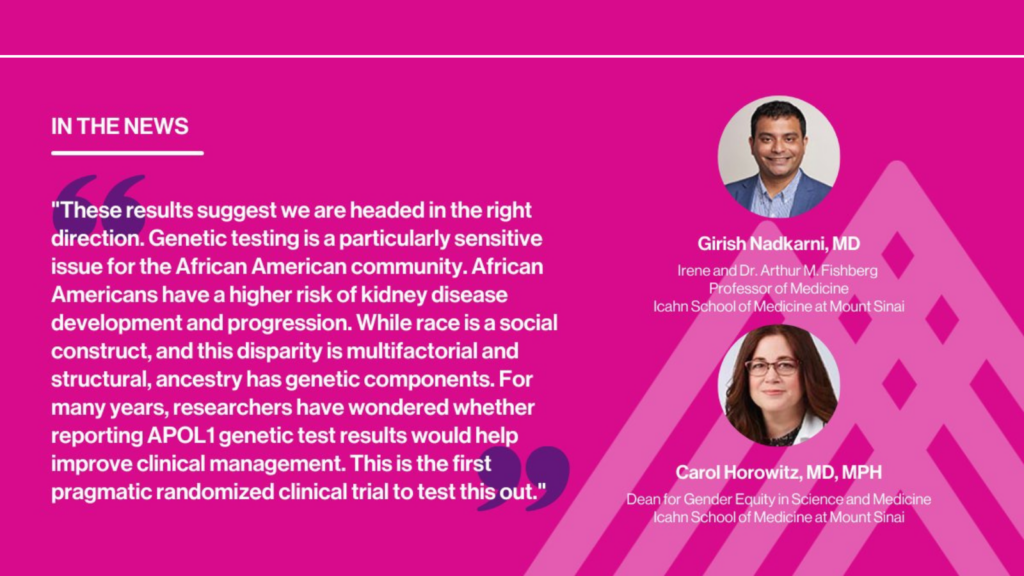 Mount Sinai, lead site for GUARDD-US, saw drops in blood pressure for hypertensive patients, supporting further trials and extensive community involvement