

 GMKB
GMKB
Join us for our next Duke Center for Applied Genomics & Precision Medicine Forum on Feb. 10, 2022 at 12 p.m. EST
Join us for our next Duke Center for Applied Genomics & Precision Medicine Forum on Feb. 10, 2022 at 12 p.m. EST
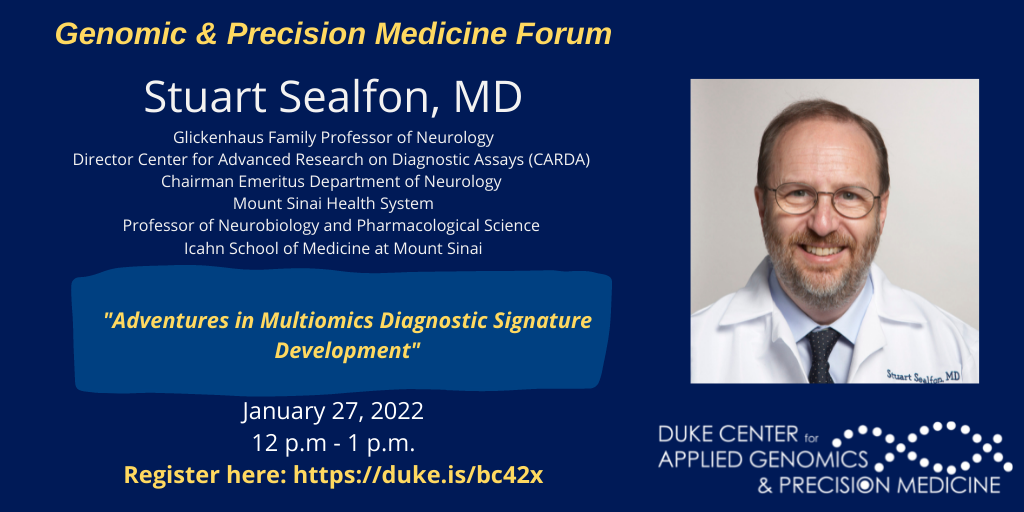 Join us for our next Duke Center for Applied Genomics & Precision Medicine Forum on Jan. 27, 2022 at 12 p.m. EST
, Kanter GP, , DM, J, S. Personalized Medicine
2022 Jan 19 :41-49. doi: 10.2217/pme-2021-0088.
PMID: 34881641
Lee G, Varughese LA , Conway L, C, , , W, DM, J,
Personalized Medicine 2022 Jan 5. doi: 10.2217/pme-2021-0064.
PMID: 34984913

Join us for our next Duke Center for Applied Genomics & Precision Medicine Forum on Jan. 13, 2022 at 12 p.m. EST
 A Special Issue of the Journal of Personalized Medicine will present cutting-edge research and commentary to characterize the future of personalized medicine. Papers from multiple disciplinary perspectives focus on topics that have practical and policy relevance to help to advance the implementation of evidence-based innovation into routine healthcare.
Please consider submitting a piece. Deadline for manuscript submission is April 20, 2022.
Learn More and Submit. Contact Nina Sperber, PhD, Guest Editor, with questions (nina.sperber@duke.edu)
There is growing interest in utilizing pharmacogenetic (PGx) testing to guide antidepressant use, but there is lack of clarity on how to implement testing into clinical practice. We administered two surveys at 17 sites that had implemented or were in the process of implementing PGx testing for antidepressants. Survey 1 collected data on the process and logistics of testing. Survey 2 asked sites to rank the importance of Consolidated Framework for Implementation Research (CFIR) constructs using best-worst scaling choice experiments. Of the 17 sites, 13 had implemented testing and four were in the planning stage. Thirteen offered testing in the outpatient setting, and nine in both outpatient/inpatient settings. PGx tests were mainly ordered by psychiatry (92%) and primary care (69%) providers. CYP2C19 and CYP2D6 were the most commonly tested genes. The justification for antidepressants selected for PGx guidance was based on Clinical Pharmacogenetics Implementation Consortium guidelines (94%) and US Food and Drug Administration (FDA; 75.6%) guidance. Both institutional (53%) and commercial laboratories (53%) were used for testing. Sites varied on the methods for returning results to providers and patients. Sites were consistent in ranking CFIR constructs and identified patient needs/resources, leadership engagement, intervention knowledge/beliefs, evidence strength and quality, and the identification of champions as most important for implementation. Sites deployed similar implementation strategies and measured similar outcomes. The process of implementing PGx testing to guide antidepressant therapy varied across sites, but key drivers for successful implementation were similar and may help guide other institutions interested in providing PGx-guided pharmacotherapy for antidepressant management.
 Join us for our next Duke Center for Applied Genomics & Precision Medicine Forum on Dec. 9 at 12 p.m. EST

Through a combination of plenaries, breakout, and poster sessions, the Annual Conference on the Science of Dissemination and Implementation in Health, co-hosted by the National Institutes of Health (NIH) and AcademyHealth, supports the collective understanding of the research agenda, addresses the challenges facing D&I science, presents research findings, and identifies the next set of research priorities – setting the field up for a strong future.