NHGRI Division of Intramural Research Seminar

Thursday, December 14 | 2 – 3 p.m. | Bethesda, MD & Online

The Division of Intramural Research (DIR) sponsors a monthly series of talks by intramural and special guest speakers celebrating genetics and genomics research. Speakers are selected by NHGRI intramural faculty and trainees and cover research topics of interest to a wide audience.

All seminars are free and open to the public. Seminar titles and other details are updated on the NHGRI website as information becomes available.

Speaker:
Marius Wernig, M.D., Ph.D.
Professor in the Departments of Pathology and Chemical and Systems Biology
Stanford University School of Medicine

Hosts: William Gahl, May Christine Malicdan and Marie Morimoto

View past presentations, learn more about upcoming seminars, and register to attend on the NHGRI website.

NHGRI Division of Intramural Research Seminar

Monday, October 30 | 2 – 3 p.m. | Bethesda, MD & Online

The Division of Intramural Research (DIR) sponsors a monthly series of talks by intramural and special guest speakers celebrating genetics and genomics research. Speakers are selected by NHGRI intramural faculty and trainees and cover research topics of interest to a wide audience.

All seminars are free and open to the public. Seminar titles and other details are updated on the NHGRI website as information becomes available.

Speaker:
Matthew Hurles, FMedSci, FRS
Director, Wellcome Sanger Institute

Co-Host:
Eric Green, NHGRI Office of the Director

View past presentations, learn more about upcoming seminars, and register to attend on the NHGRI website.

NIH funds new Genomics and Public Service Fellowship Program

The National Human Genome Research Institute (NHGRI), part of the National Institutes of Health, has awarded the American Society of Human Genetics (ASHG) a five-year, $7.1 million contract to support a new Genomics and Public Service Fellowship Program, which will provide early-stage professionals with experience in a range of genomics careers.

“Careers in genomics extend well beyond the laboratory now. There is an entire rainbow of opportunities to advance genomics in research, medicine and society,” said NHGRI Director Eric Green, M.D., Ph.D. “Future advances in genomics will need the next generation of minds working in the education, communications, policy and scientific program areas. This new ASHG-NHGRI fellowship program will provide novel training opportunities to foster such experts.”

Read the full press release on the NHGRI website.

NHGRI Division of Intramural Research Seminar

Thursday, September 21 | 2 – 3 p.m. | Bethesda, MD & Online

The Division of Intramural Research (DIR) sponsors a monthly series of talks by intramural and special guest speakers celebrating genetics and genomics research. Speakers are selected by NHGRI intramural faculty and trainees and cover research topics of interest to a wide audience.

All seminars are free and open to the public. Seminar titles and other details are updated on the NHGRI website as information becomes available.

Speaker:
Brittany Adamson, Ph.D.
Assistant Professor, Department of Molecular Biology and the Lewis-Sigler Institute for Integrative Genomics
Princeton University

Hosts: Meru Sadhu and Annette Iturralde Guerrero

View past presentations, learn more about upcoming seminars, and register to attend on the NHGRI website.

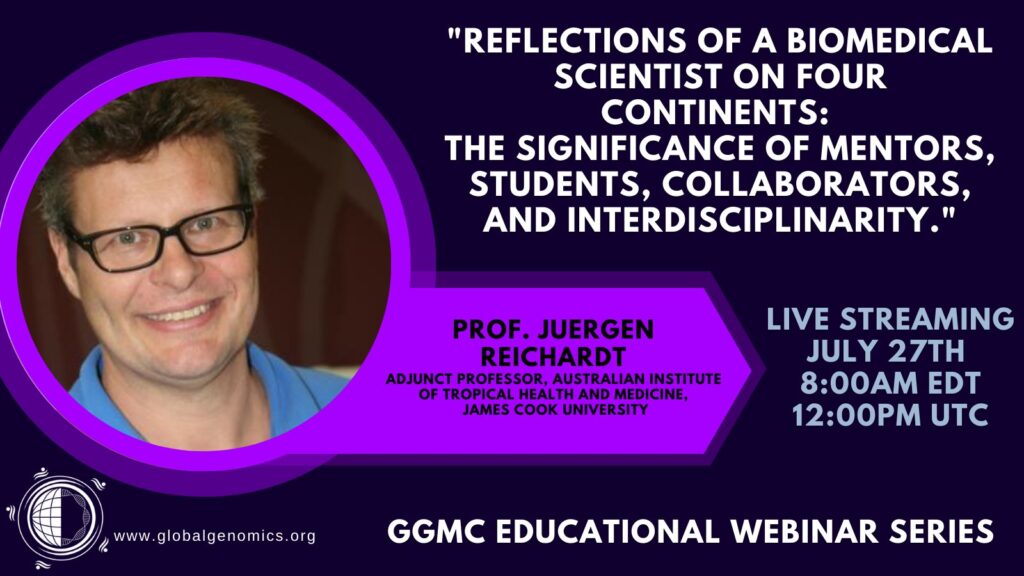
Reflections of a Biomedical Scientist on Four Continents: The Significance of Mentors, Students, Collaborators, and Interdisciplinarity

Thursday, July 27 | 8 a.m. ET | Online

Speaker: Prof. Juergen Reichardt, Adjunct Professor, Australian Institute of Tropical Health and Medicine, James Cook University

Topic: Reflections of a Biomedical Scientist on Four Continents: The Significance of Mentors, Students, Collaborators, and Interdisciplinarity

To learn more and register, visit the GGMC Educational Webinar Series webpage, previously hosted by the International Hundred K+ Consortium (IHCC).

Please note: Registration is required for this webinar.

NASEM Report Says Researchers Need to Rethink and Justify How and Why Race, Ethnicity, and Ancestry Labels Are Used in Genetics and Genomics Research

Researchers and scientists who utilize genetic and genomic data should rethink and justify how and why they use race, ethnicity, and ancestry labels in their work, says a new National Academies of Sciences, Engineering, and Medicine (NASEM) report.
The report says researchers should not use race as a proxy for describing human genetic variation. Race is a social concept, but it is often used in genomics and genetics research as a surrogate for describing human genetic differences, which is misleading, inaccurate, and harmful. To improve genomics research, the report presents a new framework and decision tree to help researchers choose descriptors and labels that are most appropriate for their study.

From the beginning of genetics and genomics research, researchers have used “population descriptors” as a shorthand for capturing the complex patterns of human genetic variation across the globe. For example, these descriptors can identify groups based on nationality, such as French; geography, such as North American; or ethnicity, such as Hispanic. But human genetic differences are distributed in complex ways that do not necessarily align with a single descriptor.

Read the full news release and report on the NASEM website.


Are We Ready for the Era of Genomic Medicine?

Friday, March 24 | 8 a.m. ET | Durham, NC & Online

Lori Orlando, MD, MHS, MMCI, Director of the Duke Precision Medicine Program and professor of medicine in the division of General Internal Medicine, will present at Medicine Grand Rounds on Fri., March 24, 2023. Dr. Orlando will present, “Are We Ready for the Era of Genomic Medicine?”, sharing why precision medicine has the potential to prevent disease, detect it early, and provide patients personalized interventions.

Learn more on the Department of Medicine website.

Data-driven Approaches to Define Rare Genetic Diseases

Thursday, March 23 | 3 – 4:15 p.m. ET | Online

Beginning September 2022, NHGRI will host a new seminar series based on its Genomic Innovator Award Program, which supports innovative work by early-career genomics investigators who are part of consortia or other team-science efforts. Each seminar will feature an early-career researcher and an established researcher. Their presentations will cover specific topics that showcase the creative ways that early-career investigators are accelerating genomics research.

Each seminar will include two speakers (each giving 20-minute talks) followed by a moderated Q&A session.

This seminar will be presented by speakers Melissa Haendel, Ph.D., FACMI of the University of Colorado Anschutz Medical Campus and Jessica Chong, Ph.D. of the University of Washington School of Medicine.

Please note: registration is required. Learn more and register on the Genomic Innovator Seminar Series website.

Precision Nutrition: Connections Between Food, Environment & Health Mini-Symposium

Wednesday, March 22 | 2-4 p.m. ET | Online

Join the UNC Program for Precision Medicine in Healthcare (PPMH) for Precision Nutrition: Connections Between Food, Environment & Health, a free virtual mini-symposium on Wednesday March 22, 2023 from 2:00-4:00pm ET. At this interactive event, you will engage in discussion with leading precision nutrition researchers at UNC.

Precision nutrition is an emerging personalized approach to nutrition that takes into account an individual’s unique dietary needs, lifestyle factors, and genetic makeup. This approach recognizes the intricate relationship between diet, environment, and health, acknowledging that what we eat and how we live can significantly impact our wellbeing. A precision nutrition approach also considers the individual’s unique health goals, such as managing a chronic condition or maintaining a healthy weight. By taking into account all of these factors, precision nutrition can help individuals make informed choices about their diet and lifestyle and achieve optimal health outcomes. Ultimately, precision nutrition recognizes that there is no one-size-fits-all approach to nutrition and health, and it tailors dietary recommendations and interventions to the individual.

Learn more and register on the UNC Precision Medicine website.

Leveraging Genomics to Address Health Disparities in Rare Diseases and Cancer Screenings

Thursday, February 16 | 3:30 – 4:30 p.m. ET | Online & Bethesda, MD

C. Jimmy Lin, M.D., Ph.D., MHS is the Founder and Chief Executive Officer of Rare Genomics (RG) Institute, an international non-profit founded in 2011 to enable any community to leverage cutting-edge biotechnology to advance understanding of rare diseases. Dr. Lin is also the Chief Scientific Officer at Freenome, working on early diagnostic of cancers. Prior to Freenome, he was the Chief Scientific Officer, Oncology at Natera where he led the development of new diagnostic technologies for cancer.

Before his career in private industry, Dr. Lin led the ClinOmics program at the National Cancer Institute (NIH/NCI) and was a research instructor at Washington University in St. Louis. Dr. Lin earned his MD and PhD from Johns Hopkins School of Medicine and a Master of Health Science from the Johns Hopkins Bloomberg School of Public Health, creating genome-wide maps of breast, colorectal, pancreatic, glioblastoma, medulloblastoma, and melanoma cancers, as well as mapping the genome of an anaerobic bacteria that is used as anti-tumor therapy. He is a 2016 Senior TED Fellow and a 2016 WIRED Innovation Fellow and has been featured in several media outlets, including Forbes, Bloomberg, Wall Street Journal, New York Times, Washington Post, BBC, and TIME Magazine.

Register on the NGHRI Genomics and Health Disparities Lecture Series website.