

 GMKB
GMKBInterested in developing clinical tools to enhance how patients use genomic information? Read more and apply>>
IGNITE’s GUARDD pilot study determines effects of testing genetic risk for kidney failure
 The Implementing GeNomics In practice (IGNITE) Pragmatic Clinical Trials Network’s GUARDD-US study has published their main outcomes paper of the pilot study, whose aim is to determine the effect of returning Apolipoprotein L1 (APOL1) genetic risk information to hypertensive African ancestry patients.
“Effects of Testing and Disclosing Ancestry-Specific Genetic Risk for Kidney Failure on Patients and Health Care Professionals,” was published in JAMA Network Open in March 2022.
Chronic kidney disease (CKD) affects 26 million US adults.1 Individuals of African ancestry have a higher risk of CKD and end-stage kidney disease compared to individuals with European ancestry owing to social determinants, clinical factors, and health system factors.1–3 Race and ethnicity are social constructs, but ancestry has some biological underpinnings. The high-risk genotypes in the APOL1 gene are found in 1 of 7 people of African ancestry.
Through the randomized clinical trial, 2050 patients of African ancestry with hypertension without chronic kidney disease in which genetic testing results were disclosed to patients and clinicians, patients with high-risk APOL1 genotypes had greater improvement in blood pressure from baseline and more lifestyle changes compared with patients with low-risk APOL1 genotypes or control patients.
“Disclosing APOL1 genetic testing results to patients of African ancestry with hypertension and their clinicians was associated with a greater reduction in systolic blood pressure, increased kidney disease screening and positive self-reported behavior changes (eg, taking blood pressure medications regularly) in those with genetic high risk,” said Carol Horowitz, MD, MPH, Professor of Population Health Science and Policy and Medicine at Icahn School of Medicine at Mount Sinai.
Researchers have found that disclosing these genetic testing results ultimately are a benefit to patients.
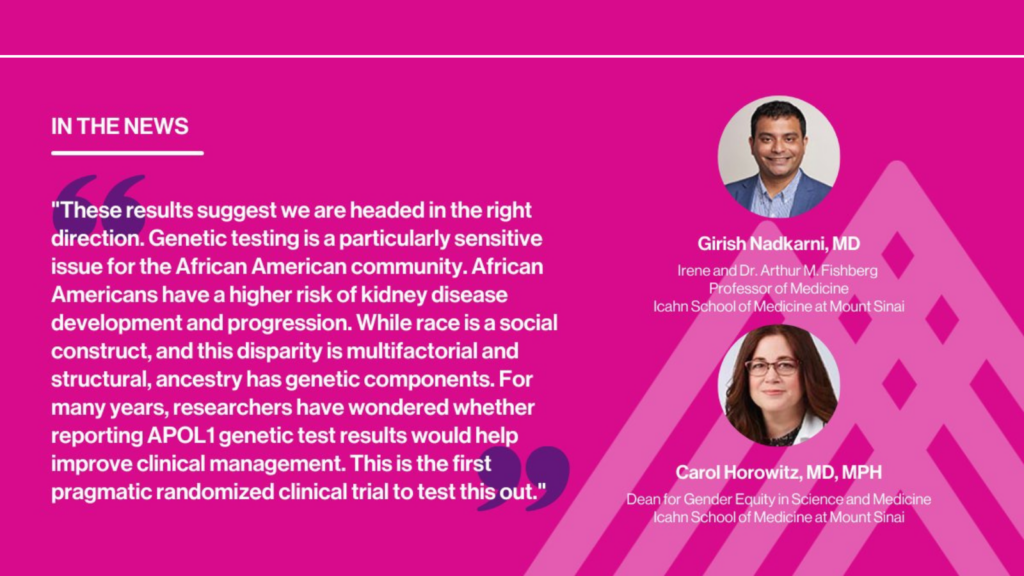
“These results suggest we are headed in the right direction. Genetic testing is a particularly sensitive issue for the African American community. African Americans have a higher risk of kidney disease development and progression. While race is a social construct, and this disparity is multifactorial and structural, ancestry has genetic components,” said Girish N. Nadkarni, MD, MPH, the Irene and Dr. Arthur M. Fishberg Professor of Medicine at Icahn Mount Sinai and the lead author of the study. “For many years, researchers have wondered whether reporting APOL1 genetic test results would help improve clinical management. This is the first pragmatic randomized clinical trial to test this out.”
“Additionally, we also show that trained laypersons can play a critical role in returning genetic results. This provides a new paradigm for return of genetic results especially in racial and ethnic minorities,” said Dr. Horowitz.
About IGNITE:
The Implementing GeNomics In practice (IGNITE) Pragmatic Clinical Trials Network is an NIH-funded network dedicated to advancing the implementation of genomics in healthcare.
With oversight from the National Human Genome Research Institute (NHGRI), the Network is comprised of a coordinating center at Duke University School Medicine and five clinical groups: Indiana University Health, Mount Sinai Health System, Duke University School of Medicine and Duke Health, University of Florida Health, and Vanderbilt University Medical Center. Additionally, the Network engages affiliate institutions across the country to encourage sharing of innovative research and best practices in genomic medicine implementation.
The IGNITE Network is conducting two genomic medicine pragmatic trials:
- ADOPT-PGx is an umbrella protocol for three pragmatic clinical trials investigating pharmacogenomics (PGx)-guided therapy for acute post-surgical pain, chronic pain, and depression. Pain and depression impact substantial proportions of the U.S. population, but finding safe, effective drug therapies remains challenging.
- GUARDD-US is a pragmatic clinical trial that aims to determine the effect of returning apolipoprotein L1 (APOL1) genetic risk information to hypertensive African ancestry patients and their primary care providers, with a focus on the control of systolic blood pressure.
These trials aim to help researchers and clinicians understand what to expect with the return of genetic information to patients and providers in real-world clinical settings. Learn more about IGNITE.
Could a Community-Based Approach to Genetic Testing Help African Americans Reduce Risks of Chronic Kidney Disease?
 Mount Sinai, lead site for GUARDD-US, saw drops in blood pressure for hypertensive patients, supporting further trials and extensive community involvement
IGNITE celebrates Medical Genetics Awareness Week
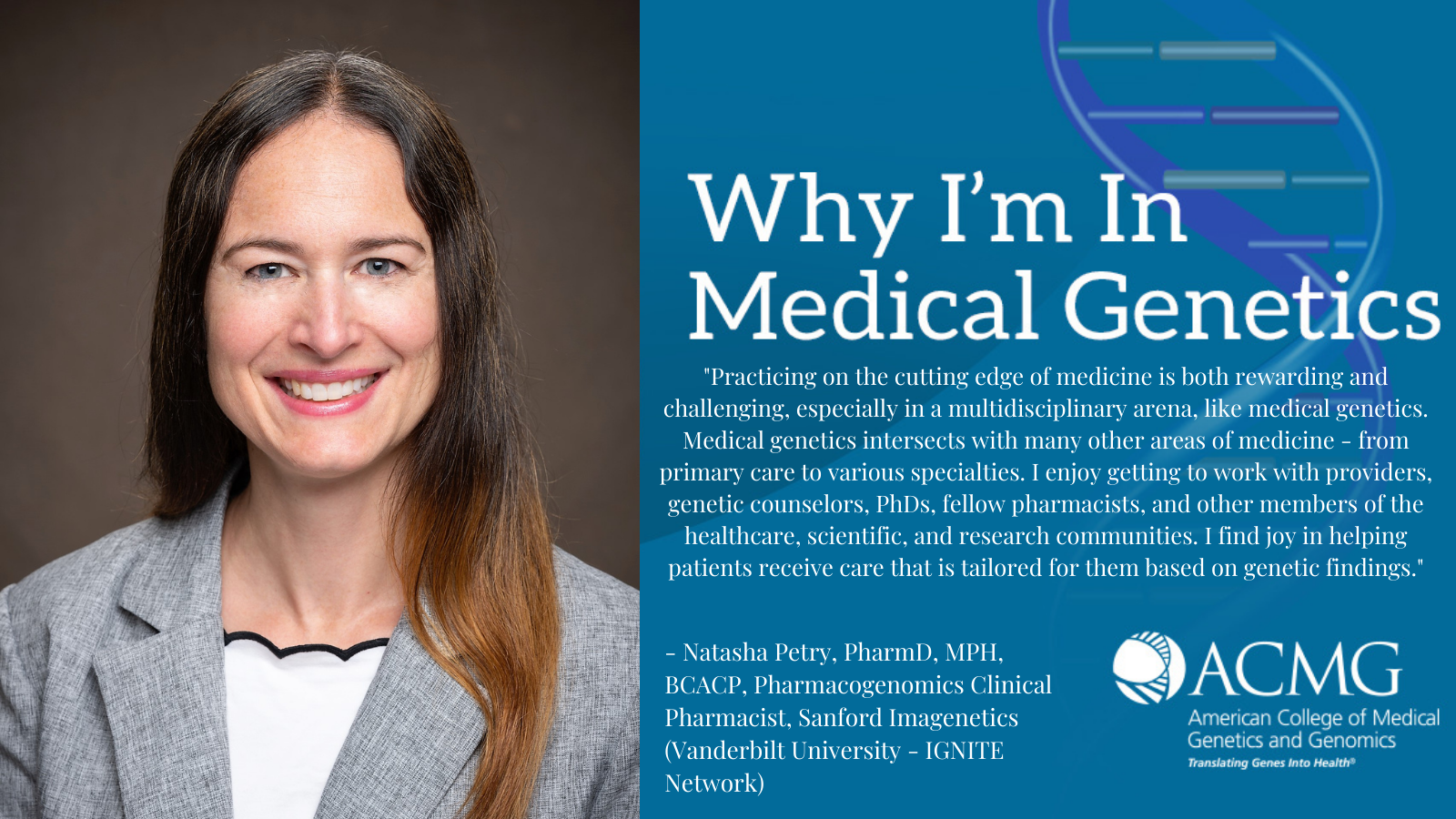 Natasha Petry, PharmD, MPH, BCACP, Pharmacogenomics Clinical Pharmacist at Sanford Imagenetics is part of Vanderbilt University’s clinical site with the IGNITE Network.
UNC’s Joint Postdoctoral Fellowship in Clinical Ethics and the ELSI of Precision Medicine
IGNITE network affiliate, UNC Program for Precision Medicine in Health Care, has posted an opportunity for a joint postdoctoral position in clinical ethics & the ethical, legal, and social implications of precision medicine.
RFA: Supporting Talented Early Career Researchers in Genomics (R01 Clinical Trial Optional)
This Funding Opportunity Announcement is intended to identify and support research projects by exceptionally promising Early Stage Investigators with a long-term career interest in pursuing innovative research in genomics. This opportunity is open to research in all areas relevant to the mission of NHGRI, including genomic sciences, genomic medicine, genomic data science, and ethical, legal, and social implications of genomics.
Notice of Special Interest: Development and Implementation of Clinical Informatics Tools to Enhance Patients’ Use of Genomic Information
The National Human Genome Research Institute has issued Notice of Special Interest NOT-HG-22-011 to encourage applications to develop and implement patient-facing genomic-based clinical informatics tools that facilitate or enhance patient-provider electronic communication, patient tracking and registry functions, patient self-management and support, provider electronic prescribing, test tracking, referral tracking, and health care decision-making.
Please direct all inquiries to the Scientific/Research Contact:
Ken Wiley, Jr., Ph.D.
National Human Genome Research Institute (NHGRI)
Division of Genomic Medicine
Telephone: 301-435-5540
Email: ken.wiley@nih.gov
CAGPM’s MeTree software recommended by President’s Cancer Panel

Lori Orlando (Duke Center for Applied Genomics & Precision Medicine) and the MeTree team highlighted in the Panel’s Closing Gaps in Cancer Screening Report to President Biden
New Leadership Announced for Coordinating Center
The Implementing GeNomics In practice (IGNITE) Pragmatic Clinical Trials Network is an NIH- funded network dedicated to supporting the implementation of genomics in healthcare.
Effective January 2022, Christina Wyatt, MD, associate professor of medicine (Nephrology) and Scott Palmer, MD, MHS, professor of medicine (Pulmonary, Allergy, and Critical Care Medicine) will replace Geoff Ginsburg, MD, PhD, as principal investigators for the IGNITE Pragmatic Clinical Trials Network coordinating center. Ginsburg recently was announced as the National Institutes of Health (NIH) Chief Medical and Scientific Officer for the All of Us research program.
Dr. Wyatt and Dr. Palmer will join Hrishikesh Chakraborty, DrPH, to serve as joint principal investigators for Duke University, who is the coordinating center for IGNITE.
The IGNITE network is comprised of five research sites, a coordinating center, a steering committee and working groups, with oversight from The National Human Genome Research Institute (NHGRI)
Two genome medicine studies are currently being facilitated through IGNITE:
- ADOPT PGx is an umbrella protocol for three pragmatic clinical trials investigating pharmacogenomics (PGx)-guided therapy for acute post-surgical pain, chronic pain, and depression. Pain and depression impact substantial proportions of the U.S. population, but finding safe, effective drug therapies remains challenging.
- GUARDD-US is a pragmatic clinical trial that aims to determine the effect of returning apolipoprotein L1 (APOL1) genetic risk information to hypertensive African ancestry patients and their primary care providers, with a focus on the control of systolic blood pressure.
These trials aim to help researchers and clinicians understand what to expect with the return of genetic information to patients and providers in real-world clinical settings.
Learn more about the IGNITE network here
Read recent publications on IGNITE here
About the PIs:
 Dr. Christina Wyatt is Associate Professor of Medicine and a core faculty member at the Duke Clinical Research Institute. She is a clinical-translational investigator at the intersection of HIV and kidney disease, including the role of genetic susceptibility attributed to variants in APOL1. Dr. Wyatt is currently the Clinical Core Director for a multidisciplinary P01 investigating the pathogenesis of HIV-related kidney disease, the PI of an ancillary study focused on kidney disease outcomes in the START clinical trial, and a co-investigator on 5 other NIH projects including a pragmatic clinical trial in young women using concomitant hormonal contraception and HIV pre-exposure prophylaxis. In addition to serving as PI or co-investigator on ancillary studies to the START and REPRIEVE clinical trials in people with HIV, Dr. Wyatt has experience as a member of Data and Safety Monitoring Boards and Clinical Endpoint Committees for large randomized clinical trials. She is an Associate Editor of Kidney International, the highest impact journal in nephrology, and a member of the Executive Committee for Kidney Disease | Improving Global Outcomes, the leading international guidelines organization in nephrology.
 Dr. Scott Palmer is Vice Chair of Research for the Department of Medicine and Therapeutic Area for MedicinePlus at the Duke Clinical Research Institute. Dr. Palmer is clinically trained in pulmonary and critical care medicine and completed advanced training in clinical research completing an MHS degree. He brings over 20 years of NIH funded research expertise including in translational human genetics and extensive experience leading successful multicenter consortium. He has led a high impact prospective, randomized, double-blind, placebo-controlled multicenter study to prevent CMV infection after lung transplant, published in Annals of Internal Medicine. He also led as PI and coordinated through the DCRI a phase 2 multicenter study of BMS-986020, a Lysophosphatidic Acid Receptor Antagonist, that established the proof-of-concept efficacy of this class of agents for the treatment of Idiopathic pulmonary fibrosis (IPF). He led administrative coordinating center (ACC) the multicenter Lung Regeneration and Repair Consortium (LRRC) and served as MPI for the Data Coordinating Center (DCC) of the Molecular Atlas of Lung Development (LungMAP), phase 1. He currently leads as overall study PI an ongoing 50-site IPF and ILD registry (IPF-PRO/ILD-PRO) that has enrolled over 1,500 patients with IPF or ILD. He also created and led as PI the first dedicated adult lung transplant NIAID Clinical Trials in Organ Transplant (CTOT) consortium. His notable genetic studies include the identification of rare protein coding variants in telomerase related genes that underlie the development of sporadic IPF.
 Dr. Hrishikesh Chakraborty is the Associate Professor in the Department of Biostatistics and Bioinformatics, Director of Pragmatic Clinical Trial Biostatistics at the Duke Clinical Research Institute, and Co-Director of the Quantitative Sciences Core for the Center for AIDS Research (CFAR) at Duke University. Currently, he is the principal investigator (PI) for (1) IGNITE Network Coordinating Centers (CC), (2) The Biomarkers of dietary intake and exposure Consortium CC, (3) Health care systems to move guideline-based care of low back pain Data Coordinating Center (DCC), (4) Mono- vs. Duo-therapy for pediatric pulmonary arterial hypertension DCC, (5) TRANSFORM-HF trial of torsemide compare with furosemide DCC, and (6) SPIRRIT-HFPEF pragmatic, registry-based randomized clinical trial that evaluate the clinical effectiveness of spironolactone versus usual care DCC. He has served as PI, co-PI, co-Investigator, and statistical investigator for large, single, and multicenter pragmatic clinical trials, observational studies, cohort studies, cluster randomized studies, CCs, DCCs, and implementation studies. He has independent, collaborative, and consulting research experience in biostatistics, public health, biomedical, clinical, epidemiologic, and social science research, and has worked in several different therapeutic areas including HIV/AIDS and other infectious diseases, maternal and child health, and cardiology/vascular diseases. He has been involved in complex and innovative clinical trials and implementation studies and has over 25 years’ expertise in collaborative single and multi-site trial management, study design, sample size calculation, data management, data quality control, data analysis, report writing, and publication of results.
Opportunity to Publish, a special issue of the Journal of Personalized Medicine
 A Special Issue of the Journal of Personalized Medicine will present cutting-edge research and commentary to characterize the future of personalized medicine. Papers from multiple disciplinary perspectives focus on topics that have practical and policy relevance to help to advance the implementation of evidence-based innovation into routine healthcare.
Please consider submitting a piece. Deadline for manuscript submission is April 20, 2022.
Learn More and Submit. Contact Nina Sperber, PhD, Guest Editor, with questions (nina.sperber@duke.edu)