Labroots Virtual Event: Precision Medicine / Genomics / Genetics / Molecular Diagnostics

Labroots Virtual Event: Precision Medicine / Genomics / Genetics / Molecular Diagnostics

May 13 – 26 | Virtual

This free, global virtual event explores the latest advances in precision medicine, genomics, genetics, and molecular diagnostics. Featuring expert presentations, interactive sessions, and poster discussions, the program covers cutting-edge technologies, clinical applications, health equity in genomics, and breakthroughs in rare disease and precision therapeutics. Attendees can earn continuing education credits and access on-demand content for a year.

To learn more, visit the event webpage. Please note: Registration is required.

ACMG Annual Clinical Genetics Meeting

American College of Medical Genetics and Genomics Annual Clinical Genetics Meeting

March 10 – 14 | Baltimore, MD

Hosted by the American College of Medical Genetics and Genomics, this meeting brings together clinicians, researchers, and industry experts to share the latest advances in clinical genetics. The program will highlight new gene therapies, cutting-edge research, and opportunities for collaboration across the genetics and genomics community.

To learn more, visit the conference webpage. Please note: Registration is required.

ASHG Annual Meeting

American Society of Human Genetics Annual Meeting

October 14 – 18 | Boston, MA

The American Society of Human Genetics’ Annual Meeting is the largest gathering of human genetics professionals worldwide, featuring plenary lectures, symposia, workshops, and poster sessions. This five-day event brings together researchers, clinicians, and emerging leaders to share groundbreaking discoveries and shape the future of human genetics through science and collaboration.

To learn more, visit the conference webpage. Please note: Registration is required.

ASHG 2024 Annual Meeting

ASHG 2024 Annual Meeting

November 5 – 9 | Denver, Colorado

Join the American Society of Human Genetics for their 5-day meeting, which will cover a broad spectrum of topics including new technologies, applications, and research to showcase the most compelling genetics and genomics science of the year.

To learn more and register, visit the ASHG meeting webpagePlease note: Registration is required.

Value of a Genomic Result in Rare Disease Patients – Sri Lankan Experience

Value of a Genomic Result in Rare Disease Patients – Sri Lankan Experience

Thursday, June 27, 2024 | 9 a.m. ET | Virtual

Speaker: Dr. Kawmadi Gunawardena

Dr. Gunawardena will discuss the impact of genomic results in rare disease patients by illustrating interesting case scenarios of Sri Lankan patients.

To learn more and register, visit the GGMC Educational Webinar Series webpage.

Please note: Registration is required for this webinar.

Integrating Genetics into the Tanzanian Healthcare: An Overview

Integrating Genetics into the Tanzanian Healthcare: An Overview

Tuesday, May 28 | 9 a.m. ET | Virtual

Speaker: Dr. Mohamed Zahir Alimohamed

Dr. Alimohamed will provide an overview of the current landscape and future prospects of integrating genetics into healthcare practices in Tanzania, beginning by outlining the existing healthcare infrastructure and genetic services available in the country. Next, Dr. Alimohamed will discuss the challenges and opportunities faced in implementing genetic testing, counseling, and treatment options within the Tanzanian healthcare system.

To learn more and register, visit the GGMC Educational Webinar Series webpage.

Please note: Registration is required for this webinar.

Duke Genomic Seminar Series

A platform approach to develop and deploy CRISPR-Cas based experimental therapies for inborn errors of immunity in an academic/nonprofit setting

Thursday, February 8 | 2-3 p.m. ET | Bryan Neurobiology Research Building, Rm 103

Speaker: Fyodor Urnov, PhD
Professor of Molecular & Cellular Biology, University of California, Berkeley
Director of Technology & Translation, Innovative Genomics Institute

The vast majority of diseases clinically tractable by genome editing using current-state technology are not the targets of active preclinical or clinical development. Addressing this issue will require more involvement of the academic/nonprofit sector, but despite an existing charted path for advancing genome editing of specific cell types and tissues (such as T cells, hematopoietic stem cells, the liver, and the retina) to the clinic, there presently is only one open US IND for genome editing by an all-academic group. A key reason is that the current manufacturing, regulatory, and healthcare economics environment is not configured to maximize clinical impact of a technology like CRISPR-Cas. Under the framework that exists today, a pediatric patient newly diagnosed with a terminal illness such as a severe inborn error of immunity due to a never-before-seen but clinically editable mutation and a life expectancy of < 1 yr will have to wait ~3.5 years until a gene editing medicine is engineered, tested, and manufactured at an approximate total cost of $9m. An actionable path through this status quo is to develop and clinically derisk a dedicated nonclinical development path for use in academic/nonprofit settings in N=1/rare situations of dire medical need. From a technology standpoint, this will require comprehensive leveraging of the intrinsically platform nature of CRISPR-Cas gene editing. The Innovative Genomics Institute in close partnership with clinicians at UCSF and UCLA is developing such a platform focused on inborn errors of immunity, where ca 112,000 known patients suffering from 505 currently known diseases lack even a single open trial for genome editing open at the present time.

To learn more, visit Duke’s Genomic Seminar Series page.

Please note: This seminar series occurs quarterly with some events occurring virtually only and others in-person with streaming options.
Global Diversity, Local Context: The Role of Ancestry, Genetics, and Environment on Human Health

Global Diversity, Local Context: The Role of Ancestry, Genetics, and Environment on Human Health

Thursday, January 11 | 3-4 p.m. ET | In-person & Virtual

Speaker: Genevieve Wojcik, PhD, MHS
Genetic Epidemiologist and Assistant Professor of Epidemiology
Johns Hopkins Bloomberg School of Public Health

Dr. Wojcik’s research focuses on understanding the role of ancestry in genetic risk and developing solutions to address health inequities for diverse and admixed populations, as well as genetic susceptibility to infectious disease. Her most recent work explores the interaction of genetic ancestry and environment in admixed populations and downstream consequences for genetic risk prediction. Dr. Wojcik is a member of multiple NIH consortia, including the Population Architecture using Genomics and Epidemiology (PAGE) Study, the Clinical Genome Resource (ClinGen), and the Polygenic Risk Methods in Diverse Populations (PRIMED) Consortium.

The Genomics and Health Disparities Lecture Series was formed to enhance opportunities for dialogue about how innovations in genomics research and technology can impact health disparities. Topics will range from basic science to translational research.

To learn more and register, visit the lecture series page.

Please note: Zoom registration is required for virtual attendees.

NASEM | Roundtable on Genomics and Precision Health – Strategic Plan Reflection on the Roundtable’s Work Since 2020

Roundtable on Genomics and Precision Health – Strategic Plan Reflection on the Roundtable’s Work Since 2020

Wednesday, November 15 | 12 p.m. ET | Online

The Roundtable on Genomics and Precision Health will host a virtual event to highlight the work of the Roundtable since the adoption of its strategic plan in 2020. Speakers will provide their perspectives on the goals and key takeaways heard from workshop and event speakers as well as look ahead to what comes next. Public events include:

  • Improving Diversity of the Genomics Workforce: A Workshop (2021)
  • Views & Voices: Reporting Genetics and Genomics (2022)
  • Realizing the Potential of Genomics across the Continuum of Precision Health Care: A Workshop (2022)
  • Next-Generation Screening – The Promise and Perils of DNA Sequencing of Newborns at Birth: A Workshop (2023)

The event will be accessible via webinar. Learn more and register on the event page.

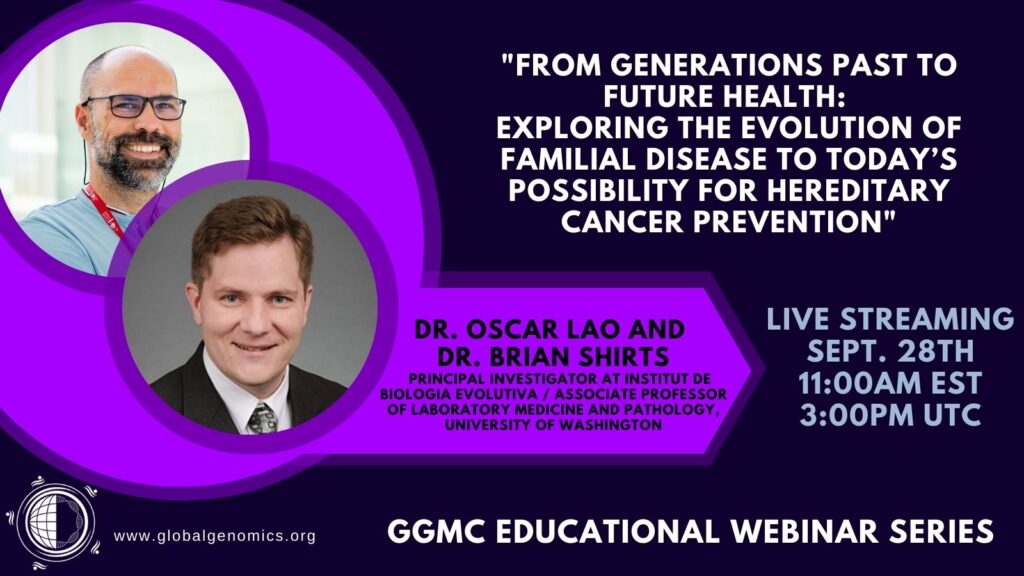
Exploring the Evolution of Familial Disease to Today’s Possibility for Hereditary Cancer Prevention

From Generations Past to Future Health: Exploring the Evolution of Familial Disease to Today’s Possibility for Hereditary Cancer Prevention

Thursday, September 28 | 11 a.m. ET | Online

Speakers: Dr. Oscar Lao, Principal Investigator at Institut de Biologia Evolutiva, and Dr. Brian Shirts, Associate Professor of Laboratory Medicine and Pathology, University of Washington

To learn more and register, visit the GGMC Educational Webinar Series webpage.

Please note: Registration is required for this webinar.